APDD is built around a disciplined methodology for transforming observation into understanding, and understanding into responsible action - while preserving the ability to learn when reality teaches something different.
FACTS ARE THE VOCABULARY. RELATIONSHIPS ARE THE LANGUAGE. REALITY IS THE MEANING.
THE APDD METHODOLOGY
A method should do more than produce an answer.
A useful methodology should make the path to an answer examinable. It should help distinguish observation from interpretation, evidence from assumption, possibility from probability, and a conclusion from the conditions that could cause that conclusion to change. APDD therefore treats reasoning as something that can be inspected, challenged, tested and corrected.
The methodology begins with an objective or question, but it does not assume that the first framing is complete. What are we actually trying to understand? What part of the whole are we seeing? From what position are we observing it? What information is present, what is absent, and what relationships may connect the pieces? These questions turn a topic into an investigation.
APDD then works outward and inward at the same time. Outward, it searches for evidence, context, alternatives, consequences and relevant relationships. Inward, it examines assumptions, definitions, classifications, reasoning steps and the confidence attached to claims. The objective is not endless analysis. It is disciplined movement toward whatever response the available evidence earns.
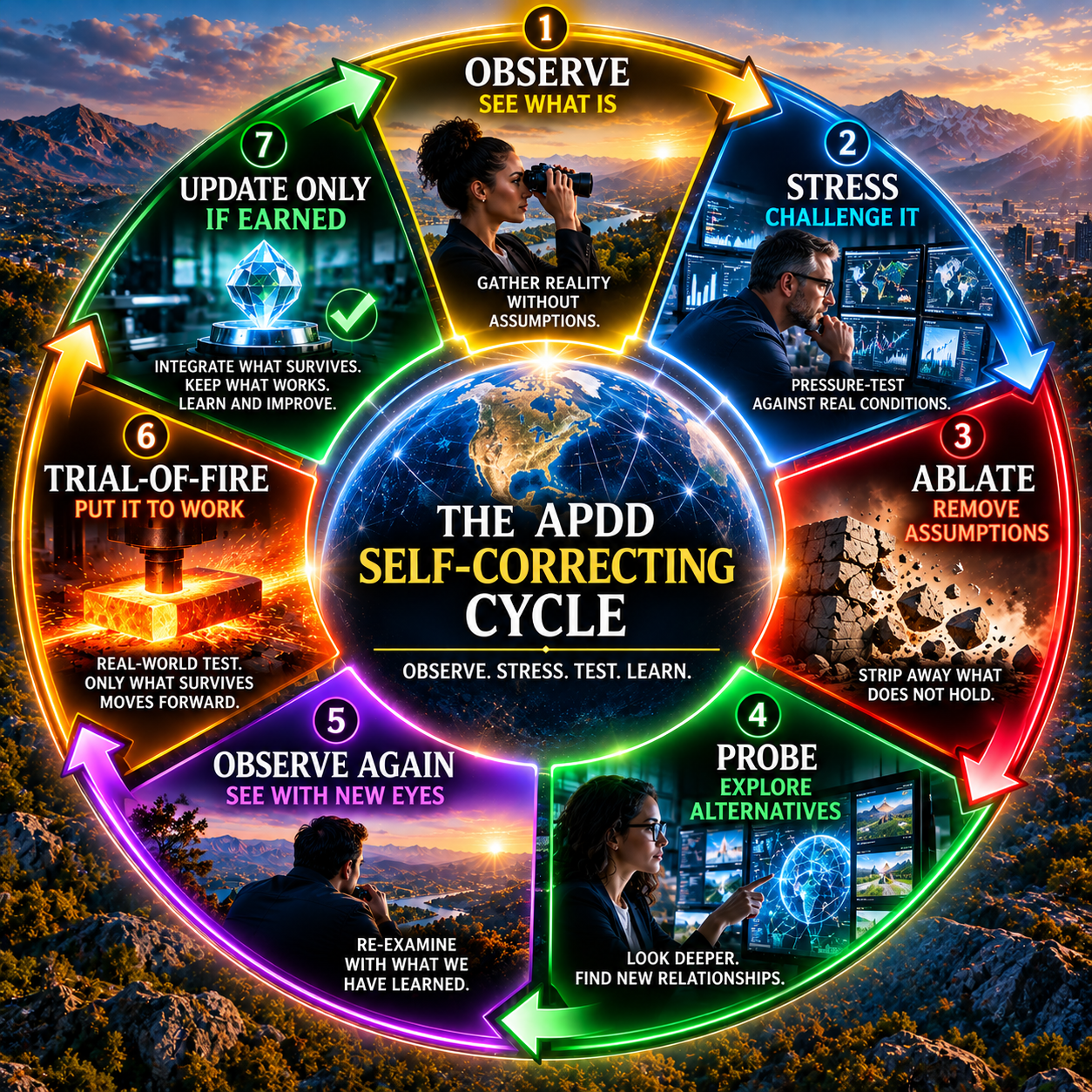
THE OPERATING CYCLE
Observe. Stress. Test. Learn.
OBSERVE→STRESS→ABLATE→PROBE→OBSERVE AGAIN→TRIAL-OF-FIRE→UPDATE ONLY IF EARNED→
OBSERVE
Notice, detect, collect, inspect and describe before explanation hardens into conclusion. Establish what appears to be present and identify the limits of the vantage point.
STRESS
Challenge the developing explanation. Look for contradictions, boundary conditions, missing variables, alternative causes and conditions under which the reasoning could fail.
ABLATE
Remove a component, assumption or dependency conceptually or experimentally. Ask what still works, what collapses and which parts were actually carrying the result.
PROBE
Ask targeted questions, compare cases, seek disconfirming evidence, test relationships and examine weak points rather than merely collecting more material that agrees.
OBSERVE AGAIN
Change the vantage point and inspect again. New evidence, failed tests or better distinctions may make the same situation look materially different.
TRIAL-OF-FIRE
Place the claim, plan, system or output under conditions capable of exposing failure. Beauty, confidence and internal agreement do not substitute for performance.
UPDATE only when the observation, evidence or result earns the update.
EVIDENCE EARNS THE RESPONSE.
Discovery can be broad. Claims must be disciplined.
APDD can explore hypotheses freely because discovery often begins before certainty exists. A possible relationship, unusual pattern, contradiction or missing explanation may deserve investigation. But an investigative lead is not automatically evidence, and evidence is not automatically proof. The methodology protects that distinction.
A hypothesis may fill a reasoning space; it may never silently fill an evidence space. APDD can ask what conditions, if they existed, could plausibly account for what is being observed. It can derive expected consequences from those conditions and compare them against reality. It can retain, revise or reject the hypothesis. Promotion in confidence occurs only when evidence earns it.
HYPOTHETICAL -> POSSIBLE -> PLAUSIBLE -> PROBABLE -> ESTABLISHED.
Agreement also requires care. Ten sources repeating one unsupported assertion do not necessarily create ten independent pieces of evidence. Multiple outputs can share a common origin, assumption, dataset or incentive. APDD therefore asks whether apparent corroboration is genuinely independent or whether it is one assumption wearing ten hats.
This is part of what we mean by LOOSE IN DISCOVERY. STRICT IN CLAIM. Discovery should have room to explore. Claims should carry labels appropriate to their support, limitations and uncertainty.
RELATIONSHIPS CHANGE WHAT FACTS CAN MEAN
Make the relationship visible.
CONNECTION
What relates to what? Is the relationship direct, indirect, causal, correlational, sequential, conditional, structural, semantic, economic, social or merely coincidental?
DEPENDENCE
What has to remain true for the explanation or plan to work? Which conditions are necessary, sufficient, optional, fragile or unknown?
DIFFERENCE
Which differences actually matter? Comparison and contrast help separate meaningful distinctions from variation that changes appearance without changing function.
CONSEQUENCE
If this relationship is real, what else should we expect to observe? Expected consequences create opportunities to test rather than merely describe.
THE INVESTIGATIVE QUESTION MARK
The question mark is being used as an instrument of cognitive expansion.
When APDD deliberately places a question mark between concepts, it is not a punctuation mistake and it is not decoration. It marks a relationship that deserves examination. The symbol interrupts automatic reading and opens a space in which the reader is invited to notice, connect, compare, question, investigate and understand.
KNOWLEDGE -> UNDERSTANDING asks whether possessing information automatically creates understanding. APDD's response is: not necessarily. Understanding requires relationships, context, distinctions and the ability to make sense of what the information means together. The question mark keeps that transition open long enough to examine what must occur between knowing and understanding.
UNDERSTANDING -> INFINITE POSSIBILITIES asks what may become newly visible when understanding changes. APDD's response is that improved understanding can reveal alternatives, questions, relationships, decisions and actions that were not apparent from the earlier vantage point. It does not guarantee infinite outcomes; it deliberately expands the field of consideration.
APDD therefore uses the question mark to ask a question and then provides its present response - including the reasoning, relationships, evidence, limitations and uncertainty behind that response. The response is not protected merely because APDD produced it.
DON'T ACCEPT EVEN THAT FORMULATION MERELY BECAUSE APDD WROTE IT. EXAMINE IT. TEST IT. CHALLENGE IT. SEE WHAT SURVIVES.
A period can close a statement. APDD's deliberately positioned question mark opens an investigative space. In practical terms it means: DO NOT PASS THIS RELATIONSHIP WITHOUT EXAMINING IT. The question mark is not there because APDD has nothing to say. It is there because there may be more to see.(TM)
The convention can also expose the structure beneath an APDD proposition: FACTS -> RELATIONSHIPS -> REALITY. APDD then offers its present response: Facts are the vocabulary. Relationships are the language. Reality is the meaning. The proposition remains open to examination, testing, challenge and correction.
THE PERMANENT QUESTIONS
Questions are instruments.
WHO is involved or affected? WHAT is happening or being claimed? WHERE does it occur or apply? WHEN did it begin, change or recur? WHICH alternatives, variables or sources matter? HOW does the mechanism, process or relationship operate? WHY is the explanation being proposed, and what evidence supports it? WHAT NEXT follows if the present understanding is correct? HOW OFTEN does the pattern recur?
These familiar words become more powerful when treated as operations rather than a checklist. How can become mechanism, procedure, sequence, implementation, pathway or method. Why can become cause, motive, purpose, justification or explanation. Which introduces selection and comparison. When can reveal chronology, frequency, delay and change. Synonyms and related meanings expand the investigative surface.
APDD can also reverse the question. What would have to be false for this conclusion to fail? What would we expect not to see? What alternative explanation produces the same apparent result? What information would change the decision? What remains unknown after the answer? A strong methodology does not merely accumulate questions; it uses questions to create discriminating tests and useful next actions.
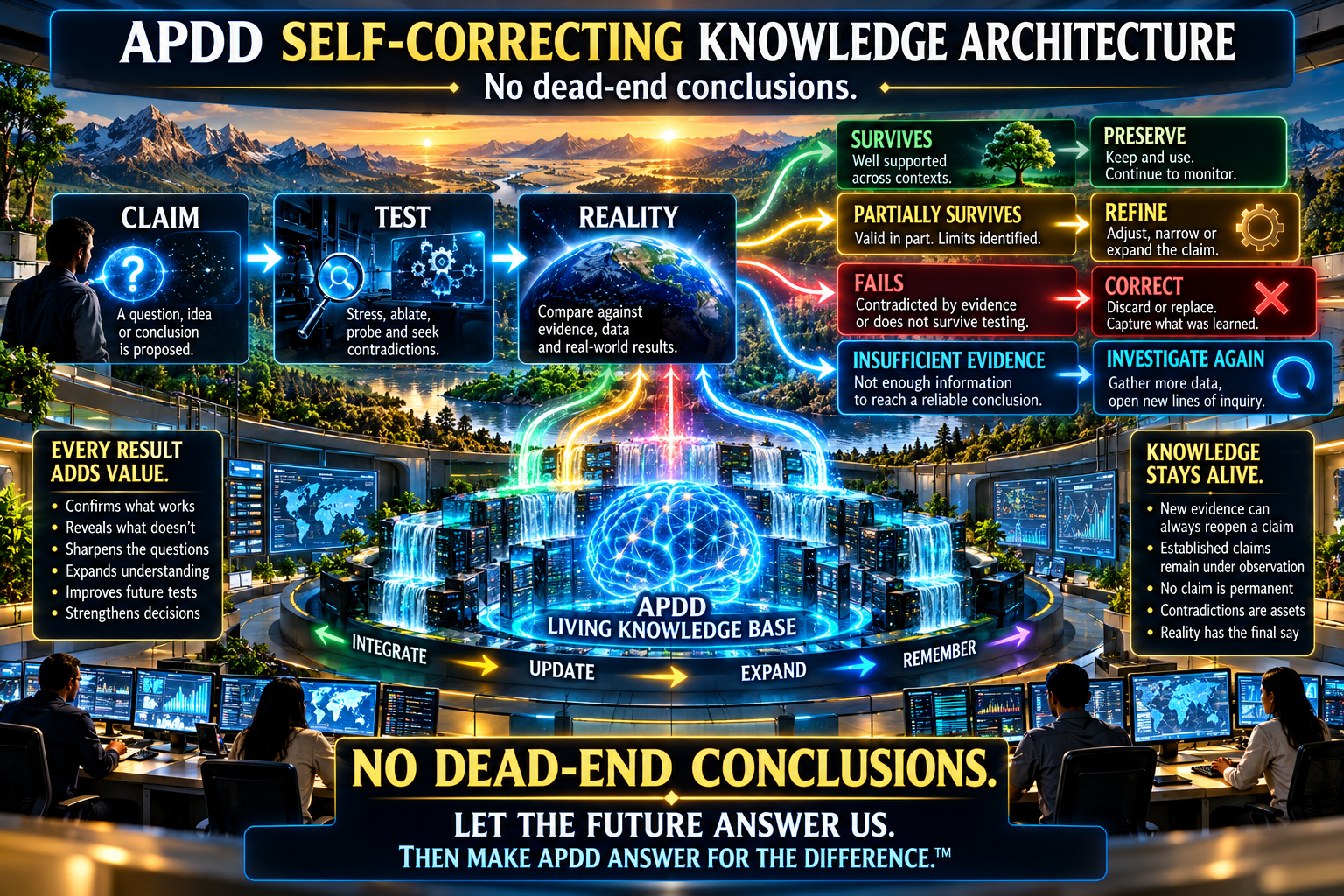
SELF-CORRECTING KNOWLEDGE ARCHITECTURE
No dead-end conclusions.
A conclusion should not become a prison. APDD treats conclusions as positions earned under particular evidence and conditions. When those conditions change - or when better evidence appears - the methodology must be able to reconsider the conclusion without silently rewriting history.
Correction can mean revising a claim, adjusting confidence, refining a model, repairing a process, replacing an assumption, changing an action, returning to investigation or acknowledging that the available information is insufficient. The important point is that correction is not treated as embarrassment. It is an operational requirement of reliability.
This creates accountability between APDD and reality. APDD carries responsibility for the reasoning process; reality supplies the accountability. If a prediction, plan or explanation meets the world and produces a different result, the difference itself becomes information. The system should ask why, identify what failed, preserve what survived and determine whether any lesson legitimately transfers elsewhere.
LET THE FUTURE ANSWER US. THEN MAKE APDD ANSWER FOR THE DIFFERENCE.
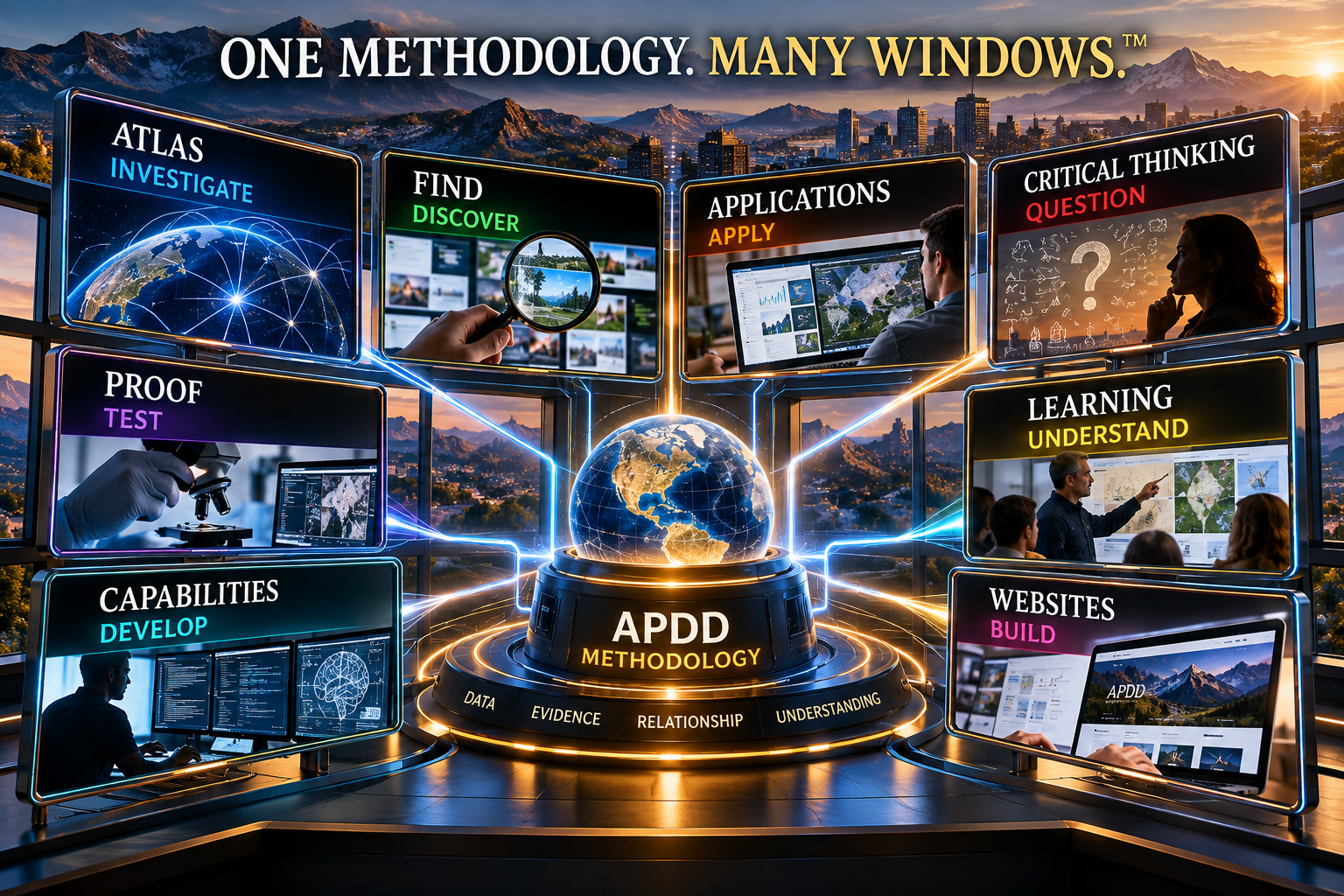
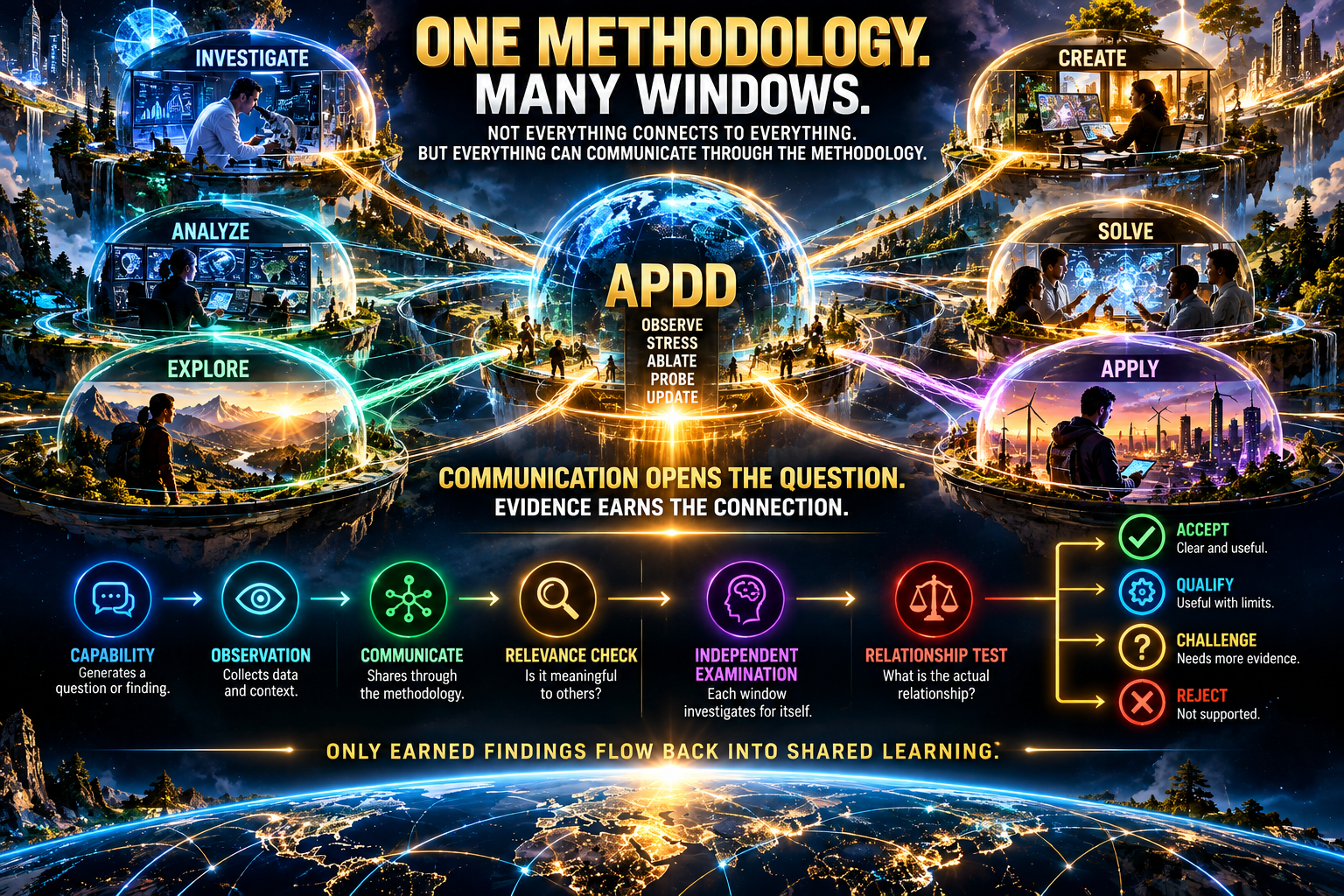
ONE METHODOLOGY. MANY WINDOWS.
Different applications. Shared discipline.
Every APDD application can be unique in what it does while remaining unified in how it thinks.
DIFFERENT OBJECTIVES
Learning, investigation, knowledge organization, comparison, planning, creation and practical problem solving can require different interfaces and tools.
SHARED OPERATIONS
Observation, evidence, relationships, distinctions, questions, alternatives, testing, decisions, consequences, measurement and correction can travel across those windows.
TRANSFER ONLY IF EARNED
A lesson learned in one window does not automatically become truth in another. APDD asks whether the relationship survives the change in context.
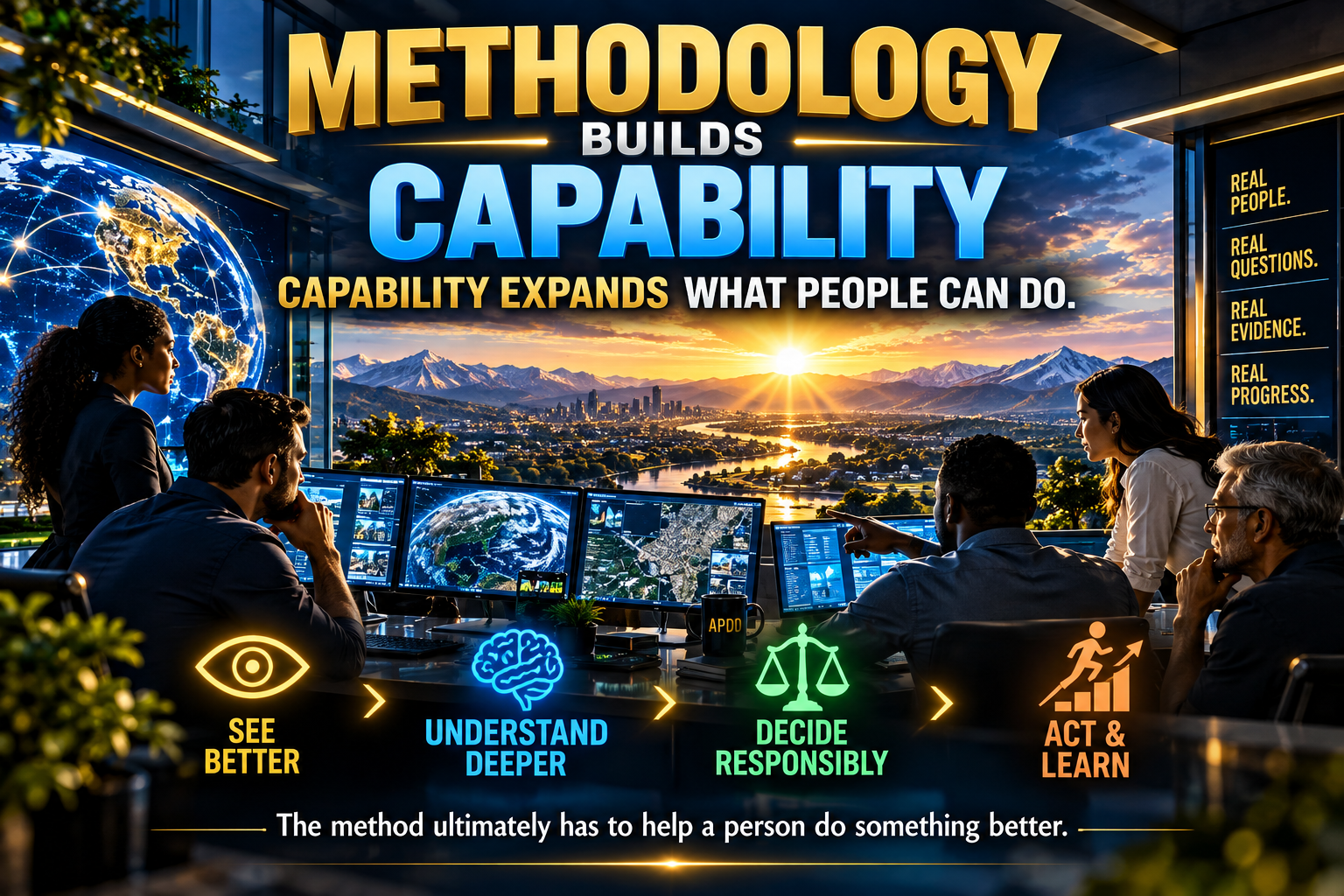
FROM METHODOLOGY TO CAPABILITY
The method ultimately has to help a person do something better.
Methodology without human usefulness becomes ceremony. APDD therefore connects its investigative discipline to capability: seeing what was not apparent, understanding relationships, distinguishing meaningful differences, questioning assumptions, discovering alternatives, deciding what deserves action, acting where appropriate, observing consequences and correcting when reality teaches something different.
This is where the Methodology page and the Empowerment page meet. The methodology describes the disciplined operations. Empowerment describes the increased human capability those operations are intended to support. The two should reinforce one another without confusing a method with a guaranteed outcome.
NOT EVERYTHING CONNECTS TO EVERYTHING. BUT EVERYTHING CAN COMMUNICATE THROUGH THE METHODOLOGY.
APDD capabilities do not all connect directly to one another, because not every relationship is relevant, useful, or real. They do, however, operate within a shared methodology that allows findings, questions, evidence, contradictions, uncertainties and results to be communicated across the system when appropriate.
A communicated finding does not automatically become an accepted finding. The receiving capability examines it from its own function and vantage point. It may use it, challenge it, qualify it, reject it, request more evidence, or discover a relationship that neither capability could see independently.
Suppose Capability A discovers something. Capability B may determine that it changes its analysis. Capability C may find it interesting but irrelevant to its objective. Capability D may challenge A's interpretation. Capability E may possess independent evidence supporting only part of A's finding. That disagreement is not a system failure. APDD wants capabilities able to communicate without being compelled to converge.
If every window receives the same information and immediately agrees, APDD has not created multiple investigative vantage points. It risks creating one assumption wearing many hats. Shared information must therefore remain available for independent examination.
SHARED INFORMATION. INDEPENDENT EXAMINATION. CONTROLLED COMMUNICATION. EARNED CONNECTION. METHOD-WIDE LEARNING ONLY WHEN JUSTIFIED.
The operating path is: CAPABILITY -> OBSERVATION -> COMMUNICATE -> RELEVANCE CHECK -> CHANGE VANTAGE POINT -> INDEPENDENT EXAMINATION -> RELATIONSHIP TEST -> ACCEPT / QUALIFY / CHALLENGE / REJECT -> RETURN TO METHODOLOGY -> LEARN IF EARNED.
APDD therefore does not attempt to make everything connect. It creates the conditions through which legitimate connections can be discovered - and illegitimate connections can be rejected. A node or signal can mean: something here may matter somewhere else. That is an opening for investigation, not a declaration of relationship.
APDD DOESN'T ASSUME EVERYTHING IS CONNECTED. APDD MAKES IT POSSIBLE FOR EVERYTHING TO COMMUNICATE - SO THE CONNECTIONS THAT MATTER HAVE AN OPPORTUNITY TO REVEAL THEMSELVES.
COMMUNICATION OPENS THE QUESTION. EVIDENCE EARNS THE CONNECTION.
The Investigative Question Mark can express that state directly: CAPABILITY A -> CAPABILITY B. APDD's response is not automatically CONNECTED. It is: A possible relationship has become visible. Investigate it.