Reach farther. Understand more. Connect what matters.
Global Reach is APDD's window for thinking beyond a single location, language, market, organization or community. It is about making useful capability easier to reach, understand and participate in across borders—without pretending that distance, language or technology automatically disappear.

What does it actually mean to reach people across the world?
Global reach is more than geography. It means examining what has to work for people to communicate, understand, participate, collaborate and make practical use of capability across different languages, technologies, circumstances and distances. Reach matters when it becomes usable.
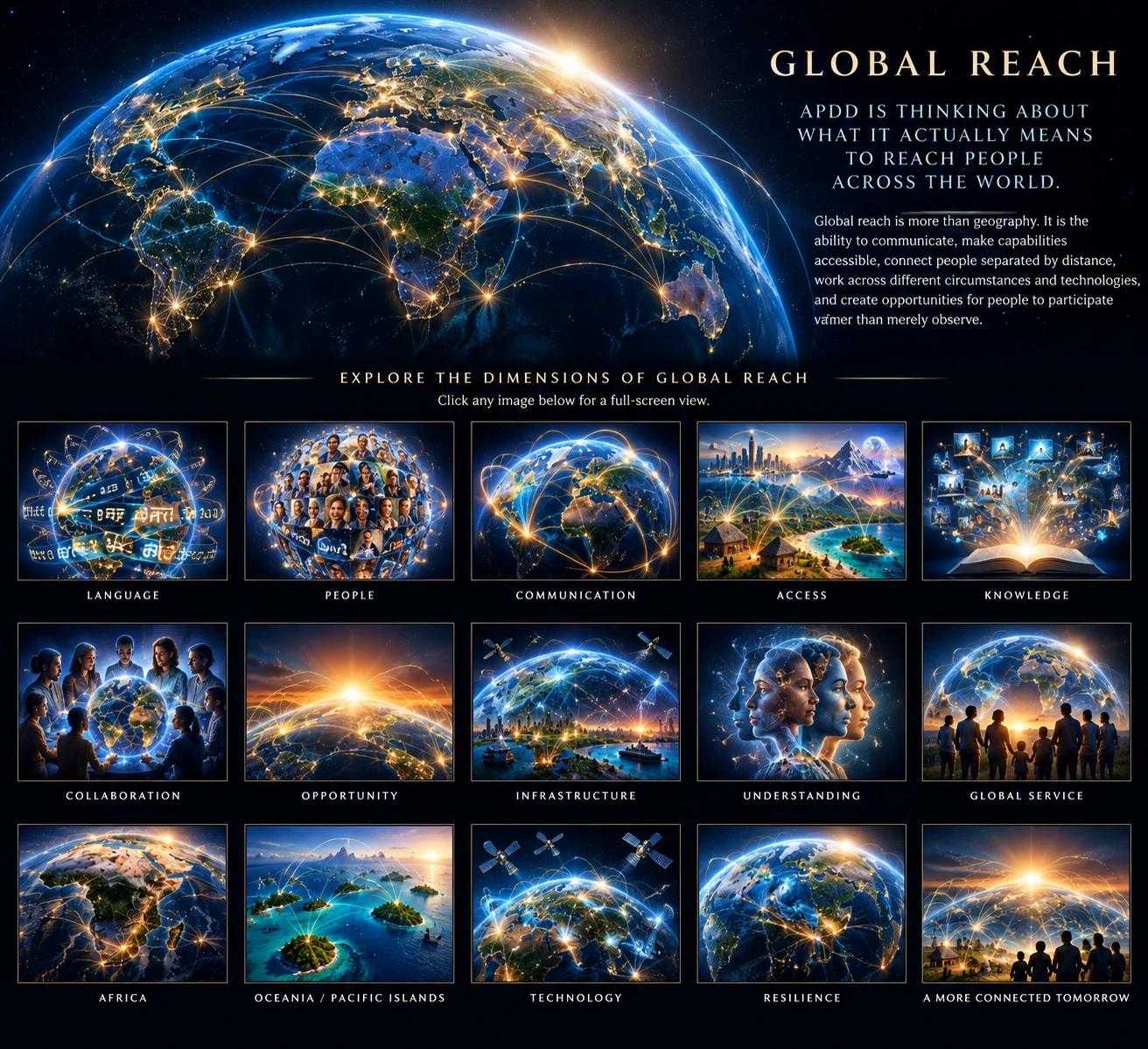
Global reach begins with people being able to connect.
A connection is useful only when information can move clearly enough for people to understand what is happening and decide what deserves action.
APDD Global Reach treats communication as more than transmission. Different languages, expectations, time zones, technical environments and local conditions can change how the same message is received. The objective is not to erase those differences. It is to make important relationships visible so participants can work with them deliberately.
That means designing information so it can be read, navigated and understood; making important context visible; distinguishing what is known from what is assumed; and creating paths for questions when meaning is uncertain. Global participation becomes stronger when communication helps people see the same evidence without demanding that everyone begin from the same background.
Access should lead somewhere useful.
Being able to open a page is not the same as being able to use what is on it.
Global digital access depends on practical details: device differences, connection speed, readable layouts, understandable navigation, responsive design and technology that does not create unnecessary barriers. APDD approaches these as operating conditions, not decorative features.
Global Reach therefore connects accessibility with capability. The question is not merely whether information is online. The question is whether a person can find it, understand its purpose, use the relevant capability and see what happened as a result. Where technology introduces friction, that friction becomes something to observe and improve rather than something to hide behind a polished interface.
Language assistance must help preserve meaning.
Global Reach is being designed around reading, interpretation and translation assistance, with a simple rule: the public page should claim only what has actually been implemented and tested.
Reading
Content should be structured so people can follow the page, locate important information and move through it without unnecessary complexity.
Translation
Cross-language assistance can widen participation, but translated words still require context. APDD will not present an untested translation feature as though it guarantees perfect meaning.
Interpretation
Where interpretation assistance is introduced, the goal is practical understanding: preserve intent, expose uncertainty and provide a path to clarification when language alone is insufficient.

Connection can create opportunity—but opportunity still has to earn its value.
Global Reach can help expose relationships between needs, capabilities, organizations, communities, partners and possible applications. APDD does not treat every connection as a good connection. A useful opportunity should survive questions about fit, evidence, cost, burden, implementation and actual benefit.
That distinction matters globally because scale can amplify both value and error. A promising idea that works in one setting may encounter different infrastructure, regulation, language, economics or expectations elsewhere. Global Reach keeps those differences visible so expansion becomes an investigation rather than an assumption.
The result is a more disciplined kind of reach: find possibilities, examine the conditions surrounding them, test what can be tested and let evidence determine what deserves to continue.
Different environments can teach us different things.
A broader field of observation can reveal assumptions that remain invisible when everything is tested in one setting.
APDD Global Reach treats differences as potential information. A capability may encounter an unexpected use, a new constraint, a missing relationship or a better way of solving the same problem. Those observations can generate new questions for investigation. They do not automatically become facts, features or public claims.
This is where learning and innovation meet discipline. New possibilities can be explored freely, while consequential changes still have to survive testing. What works can be retained. What fails becomes information. What remains uncertain stays labeled as uncertain.
Reach depends on what supports the reach.
Websites, applications, networks, data, workflows and operational support all depend on underlying infrastructure. Global Reach therefore asks a second question whenever a capability expands: what does this new reach depend on?
That question can expose bottlenecks, concentrated dependencies, reliability concerns, security requirements and operational burdens before they become invisible assumptions. APDD's broader approach is to build digital capability with structure and then challenge the structure under realistic conditions.
Resources matter too. Expansion that creates more burden than value is not automatically progress. A global system should be understandable enough to operate, maintain and correct when conditions change.
Growth should remain understandable as it grows.
Scale is useful when capability, evidence and operational control can scale with it.
Global Reach does not define success simply as more visitors, more locations or more activity. Those measures can matter, but they do not by themselves show whether people received useful capability or whether the underlying system remained reliable.
APDD looks for measurable outcomes appropriate to the capability being used. That can include participation, successful completion, response time, reliability, adoption, reduced friction or other evidence relevant to the actual purpose. The metric should follow the question—not replace it.
Sustainable reach also means remaining willing to correct. Conditions change. Technology changes. Needs change. A useful global capability must be able to observe those changes and reconsider earlier assumptions rather than treating yesterday's success as permanent proof.
The website is not the whole capability. It is a window into it.
Once reach, communication, access and operating conditions are understood, digital infrastructure can give those capabilities a practical place to work.
APDD distinguishes between simply publishing information and building an environment that supports an actual purpose. Some projects need a clear, effective website. Others require deeper infrastructure: applications, controlled workflows, evidence, security, operational continuity, integrations or other capabilities working behind the visible page.
That is why Global Reach belongs before APDD's website-development material. It establishes the people, places, conditions and communication problems first. Website development then becomes one means of delivering capability into that environment—not the definition of Global Reach itself.
That distinction also keeps the work grounded. A visitor may need information, an affiliate may need a usable operating pathway, an organization may need dependable digital infrastructure, and a community may need a clearer way to participate. Those are different needs. Global Reach provides the broader frame in which APDD can examine those differences before deciding what kind of digital delivery actually fits.
When the delivery mechanism matches the real need, the website can become more than a presentation layer. It can become an understandable doorway into applications, guidance, evidence, communication and other practical capabilities—while still keeping the person using it at the center of the design.
Structured infrastructure. Purposeful delivery. Measurable outcomes.
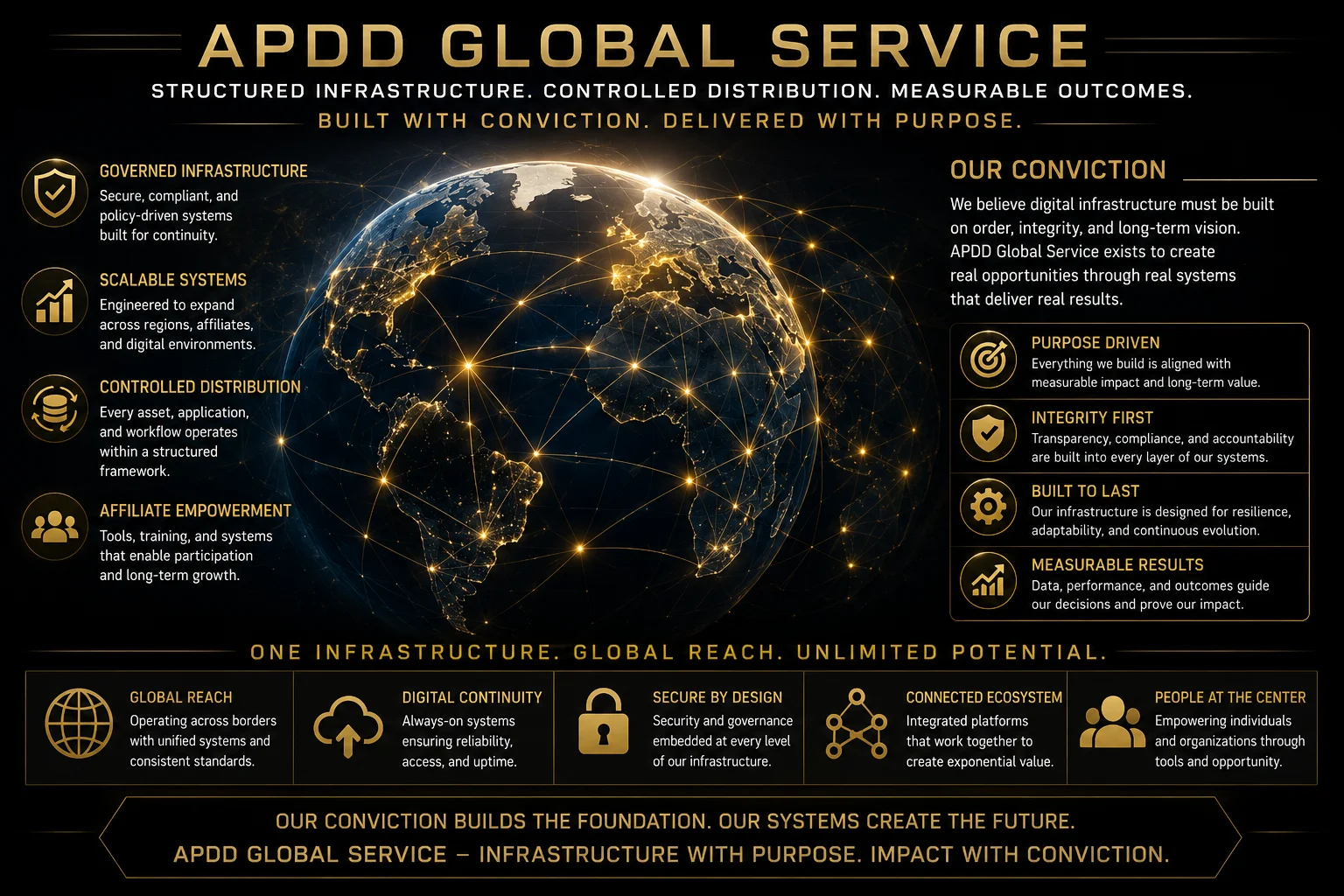
Global Reach comes together when communication, access, infrastructure, collaboration and evidence support one another rather than operating as isolated features.
The objective is not to promise unlimited outcomes. It is to build practical systems with clear purpose, observe what they actually do, and improve them when reality exposes something we missed. That is how global ambition becomes work that can be examined.
Different places. Different conditions. Connected possibilities.

Reach farther without losing sight of the relationships, evidence and people that make the reach matter.