Capability should be visible. So should its boundary.
APDD capabilities are the practical windows through which the Methodology becomes something a person can examine, use, challenge, compare or test. They include applications, investigative experiences, websites, media, demonstrations and other purpose-built digital work.
This page is not intended to turn every experiment into a product claim. Its job is to show what APDD is building and demonstrating while keeping an equally important distinction visible: a capability can exist at different levels of readiness.
A prototype can demonstrate an idea. A working application can perform a defined job. A controlled demonstration can provide evidence under known conditions. A production system has to survive broader operational demands. Those are not interchangeable states.
APDD therefore treats readiness as part of the description rather than a footnote. When a capability is exploratory, pre-release, demonstrated, operational or still being tested, the label should reflect the evidence available at that moment.
Capability is not permission to overclaim. A polished interface, successful demonstration or promising result does not automatically establish reliability at every scale, under every condition, for every user.
FOUR DISTINCT LANES. ONE METHODOLOGY.
Different work. Shared discipline.
1. Methodology
The APDD Methodology provides the discipline underneath the public work: observe, question, investigate, distinguish evidence from assumption, stress what appears to work, examine failure and correct only when the evidence earns a change.
Purpose-built digital applications translate a defined need into usable capability. The form may involve investigation, learning, communication, workflow, knowledge organization, decision support or another bounded job.
Some websites are not simply presentations. They coordinate information, services, workflows, integrations or operational functions. APDD distinguishes that infrastructure role from an ordinary informational website.
A focused public website can still require clear information architecture, responsive design, accessibility, search visibility, performance, trust and a visitor journey that makes the purpose understandable.
ATLAS is APDD's public investigative research and analysis doorway. It is designed around questions, evidence, relationships, comparisons, competing explanations, uncertainty, contradictions, alternatives and the next useful line of inquiry.
The purpose is not to replace human judgment with a machine conclusion. ATLAS can help make more of the investigative landscape visible so that a person has more material with which to think, challenge, verify and decide.
That makes ATLAS both a capability and a demonstration of a broader APDD principle: an answer does not have to be the end of an investigation.
Search is easy to describe and difficult to do well. A useful discovery capability has to distinguish a keyword match from a meaningful result, make context visible, reduce irrelevant noise and help the person understand why something may deserve attention.
FIND represents APDD's public discovery direction: locating information, resources, relationships or relevant material around a defined need. Its value should be judged by the usefulness and traceability of what it surfaces, not merely by the number of results returned.
Where FIND remains in development or demonstration, APDD should say so. Discovery quality, coverage and reliability have to be tested rather than inferred from the existence of a search interface.
Useful assistance without hiding the human decision.
Assisted applications can organize information, surface options, guide a workflow, explain context, support comparison or reduce repetitive effort. The important boundary is whether the system is assisting a person or quietly assuming authority that still belongs to that person.
APDD's application work therefore treats assistance, automation and decision-making as different relationships. A capability may recommend, organize, translate, analyze or prompt while still leaving the relevant judgment with the user.
Video, audio, motion, visual explanation and interactive media can make an idea easier to see and understand. APDD treats media as functional communication rather than decoration alone. The question is what the medium helps the audience perceive, remember, compare or investigate.
Media production can support demonstrations, education, storytelling, product explanation and public communication. As with other capabilities, technical polish is not the only measure. The result also has to preserve the intended meaning and survive review for accuracy, usability and audience comprehension.
Interactive visual systems can expose relationships that static text may hide. A node, connection, state change or visual pattern can become a way to examine how pieces relate, where something changes, and what deserves another question.
Living Nodes™ represents this visual-interaction direction. Its public value should come from what the visitor can actually observe and test rather than from an unsupported claim about what the visualization means.
Observe the whole energy question—not just the headline.
Clean energy is not one technology, one metric or one answer. A useful investigation can involve generation, storage, transmission, materials, land and water use, reliability, cost, maintenance, safety, environmental effects, local conditions, infrastructure, policy, scale and the people who ultimately have to live with the result. APDD approaches clean-energy work as an investigative field in which those relationships should be made visible before a conclusion is treated as earned.
APDD can observe and organize developments across solar, wind, geothermal, hydroelectric, storage, grid modernization and other emerging or established energy pathways; compare claims with available evidence; identify assumptions and tradeoffs; distinguish laboratory promise from demonstrated performance; examine what changes when a technology moves from one location or scale to another; and surface questions that deserve deeper testing or qualified expertise.
Observe the Evidence
What has actually been demonstrated? Under what conditions? APDD can separate measured performance, projections, promotional claims, unresolved questions and missing evidence so they are not silently treated as equivalent.
Make the Relationships Visible
Cost can affect adoption. Storage can affect reliability. Geography can affect generation. Materials can affect supply chains. Infrastructure can affect what is practical. APDD examines the relationships surrounding a technology rather than evaluating a single number in isolation.
Compare Without Predetermining the Winner
Different energy approaches may solve different parts of a problem. APDD can compare alternatives, combinations, constraints and consequences without assuming in advance that one pathway must defeat every other pathway.
Stress the Claim
What happens at night, in extreme weather, during peak demand, after years of operation, at larger scale or when a key assumption changes? A clean-energy claim becomes more useful when it is examined under conditions capable of exposing its limits.
APDD does not declare an energy technology “clean,” superior or ready merely because the label is popular. The objective is to investigate what the evidence supports, what tradeoffs remain, what conditions matter and what would have to be learned next.
Where specialized engineering, environmental, regulatory or safety judgment is required, APDD's role is to help organize the investigative landscape and make the need for that expertise visible—not to substitute a general analytical system for qualified domain professionals.
MARKETS & SPECIALIZED DOMAINS
A methodology can enter a domain without pretending to own it.
Specialized subjects bring specialized evidence, terminology, uncertainty and risk. APDD can apply investigative and analytical discipline to a domain while remaining explicit about what is demonstrated, what requires expert knowledge, and what should not be converted into certainty.
Public experimental windows may change as testing continues. Where a specialized capability is exploratory, its status should remain visible and its conclusions should remain proportional to the evidence.
WHAT HAPPENS WHEN A CAPABILITY FAILS?
Failure is evidence about the capability.
A broken function is one kind of failure. A misleading result, inaccessible interface, weak source, poor comparison, hidden dependency, confusing workflow or claim that exceeds the evidence can be failures too.
APDD's standard is not that failure never occurs. The standard is that failures should be observable, examinable and correctable. When something breaks, the useful questions are what actually failed, under what conditions, what evidence identifies the cause, what else changed, and whether the proposed correction survives retesting.
This also protects successful work. A system should not be redesigned simply because another design is imaginable. Change earns its place by addressing an observed need, limitation or failure.
A visitor should be able to distinguish an idea from a prototype, a prototype from a demonstration, and a demonstration from a production claim. APDD's Proof material exists to make that expectation explicit.
Useful evidence can include observable behavior, reproducible tests, comparisons, documented limitations, failure cases, source verification, performance under defined conditions and evidence that a correction actually corrected the problem it was intended to address.
Confidence should grow with evidence. When evidence is incomplete, the description should remain incomplete too.
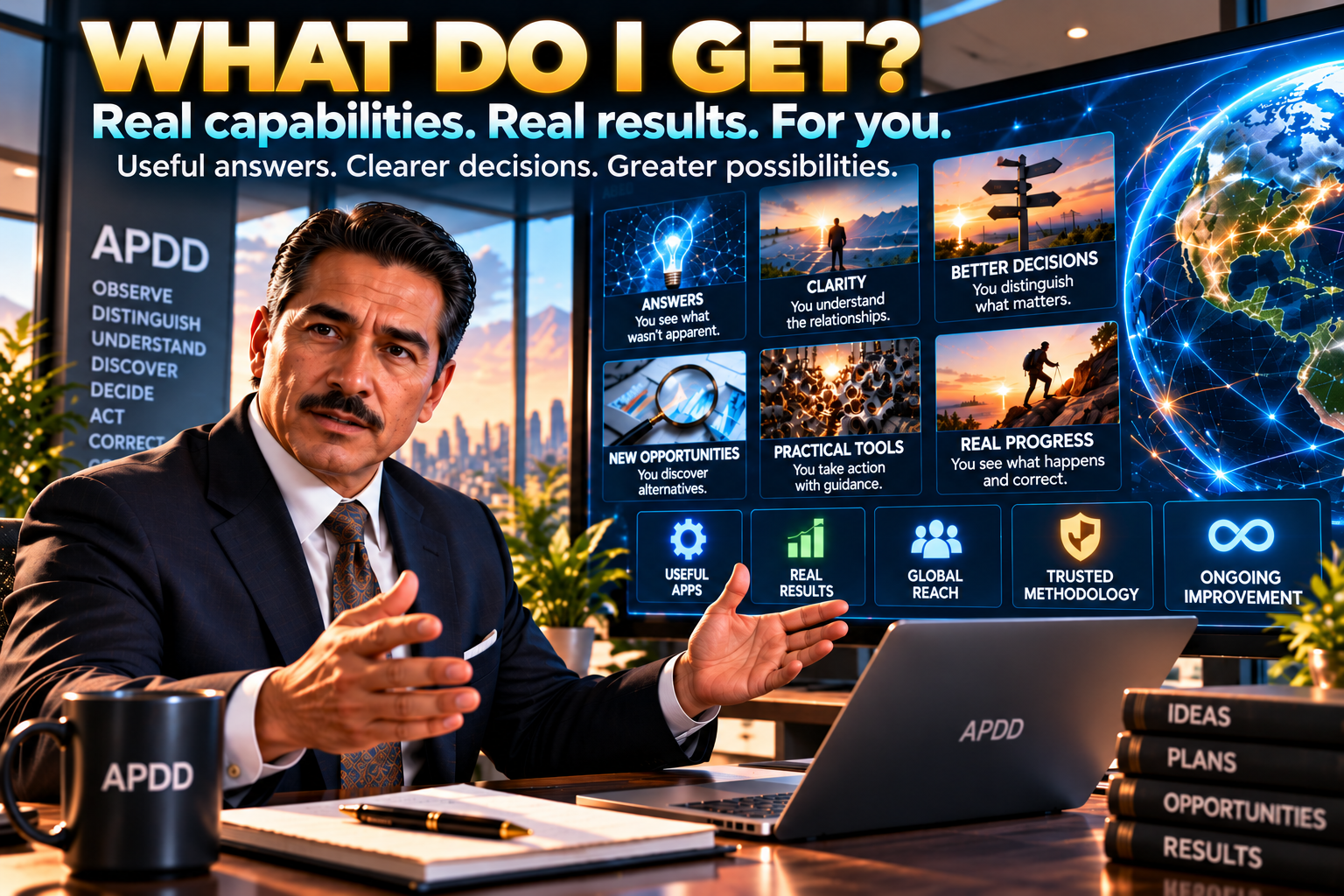
The capabilities layer gives visitors a way to move from APDD's ideas into concrete public work. You can examine the Methodology, enter the Applications Showroom, investigate with ATLAS, explore discovery and assisted-application directions, look at website and media work, and examine how APDD approaches proof, failure and correction.
The list will evolve. New capabilities may appear, existing ones may be revised, and some experimental windows may be retired when evidence shows they do not deserve continuation. That is not a contradiction of the Methodology. It is the Methodology operating on APDD itself.
Public capabilities may be at different stages of development. APDD should describe each according to what has actually been demonstrated.