Answers are useful. Understanding is different.
Artificial intelligence can make information easier to obtain, organize, compare and explain. That can be enormously useful. But speed and convenience introduce another question: when a machine performs more of the intellectual work, what happens to the human being who asked for help?
APDD does not begin by assuming that AI automatically improves critical thinking. Nor do we assume that using AI necessarily weakens it. Research is already showing a more complicated picture. How a person uses an AI system, how much confidence they place in it, what the system asks them to do, and whether they continue evaluating its output can all matter.
ATLAS should learn how to help people learn - not merely learn how to answer them.

That principle changes the objective. Correctness, relevance and speed still matter. But APDD also wants to ask whether a person leaves an investigation better able to recognize assumptions, compare evidence, identify uncertainty, discover alternatives, challenge conclusions and formulate the next useful question.
Keep the human in the investigation.
Critical thinking is not a ritual of disagreeing with everything. It is disciplined examination. It includes asking what is known, what is inferred, what is missing, what could be wrong, what other explanations fit the evidence, and what new information could change a conclusion.
ATLAS is being developed to increase the material available for thought - evidence, relationships, competing explanations, contradictions, uncertainty, alternatives and questions - without asking the user to surrender judgment.
SEE -> UNDERSTAND -> DISTINGUISH -> QUESTION -> DISCOVER -> DECIDE -> ACT -> OBSERVE -> CORRECT

The sequence matters because an answer should not automatically become a stopping point. A useful answer can expose another relationship. A contradiction can reveal a better question. New evidence can require correction. APDD wants the system to make those possibilities easier to see.
Different people need different kinds of help.
Not every question should become a lesson. Sometimes a person simply needs a direct answer. At other times the purpose is understanding, investigation or learning. APDD therefore treats assistance as a gradient rather than a single behavior.
Just tell me.
Give a concise, useful answer without turning a simple request into an unwanted course.
Help me understand.
Explain the reasoning, context, relationships and distinctions that make the answer meaningful.
Teach me.
Build understanding progressively and check whether the explanation is connecting.
Investigate this with me.
Compare evidence, challenge assumptions, test alternatives and keep examining what survives.
Test my understanding.
Reduce assistance and let the person explain, transfer or apply what they have learned independently.
The person chooses.
ATLAS may offer a direction the user may take. The user decides whether to take it.
Ask the person what is happening to their thinking.
APDD should not decide from the outside that a user is becoming a better thinker. The person using ATLAS has evidence that matters too. At appropriate moments after meaningful investigative work - not after every answer - ATLAS can invite a voluntary Critical Thinking Check-In.
Critical Thinking Check-In
After working with ATLAS, do you feel your ability to question, investigate, compare evidence, recognize assumptions, discover alternatives and reach your own conclusions is improving, about the same, getting worse, or are you not sure yet?
What did ATLAS do that helped you think more clearly? What made you rely on ATLAS instead of thinking the matter through yourself? What could ATLAS do differently to help you learn better, understand more and think more independently?
The response should change what ATLAS offers next. If the user feels they are improving, ATLAS may offer a harder transfer problem or a different vantage point. If progress feels flat, it may offer another explanation or guided comparison. If the user feels more dependent on the system, ATLAS may offer to reduce its intervention and return more of the reasoning to the person. If the user is unsure, it may offer a short independent test.
The operative word is may. The system offers. The human chooses.
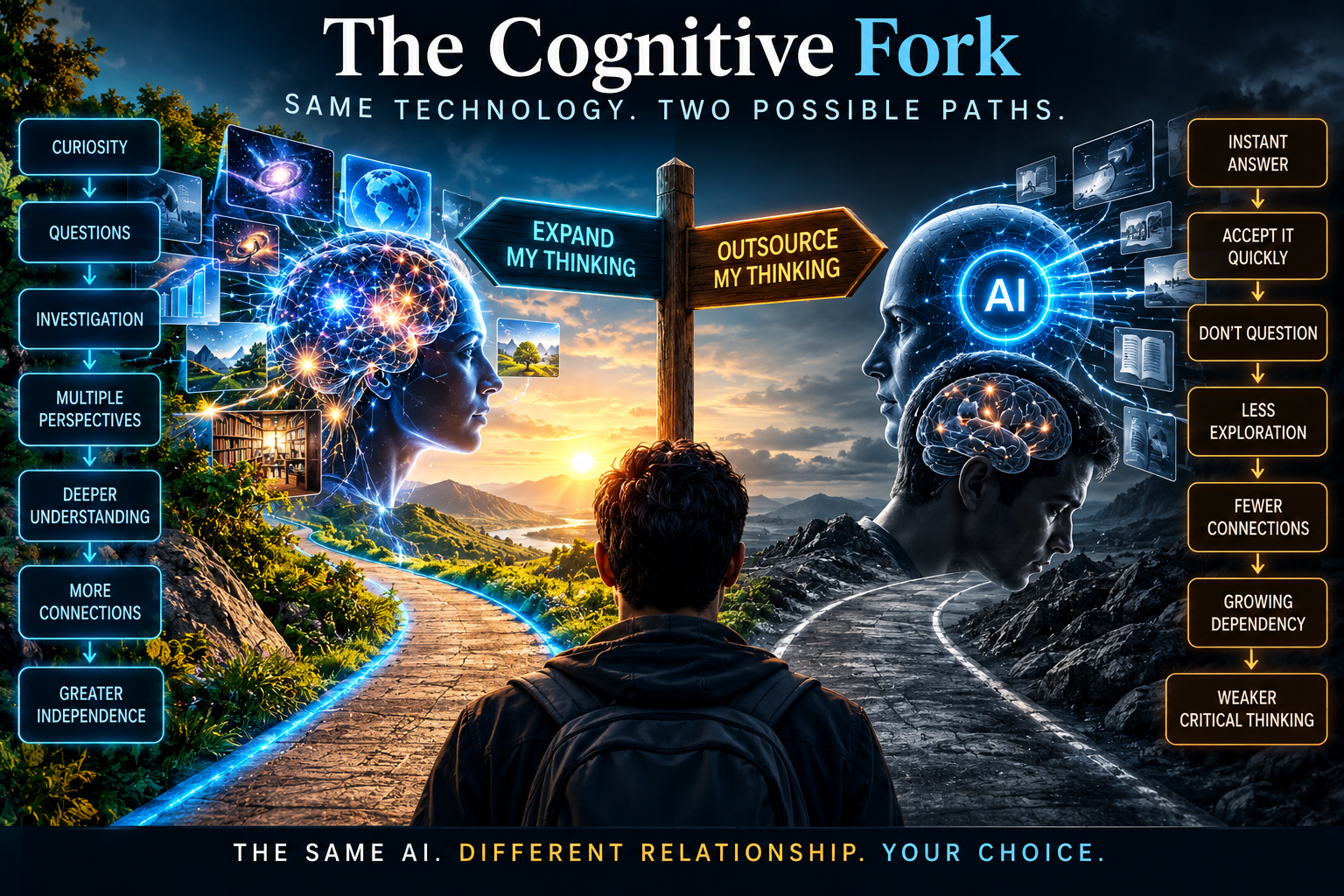
Feeling smarter is not the same as demonstrating learning.
Self-report is valuable, but it is not proof. A person may feel that they understand something because an explanation was fluent and convincing. Another person may feel less confident precisely because deeper investigation exposed complexity they had not previously noticed.
For that reason, APDD's testing should combine three forms of evidence:
What the person feels -> what the person says helped or hurt -> what the person can subsequently demonstrate independently.
Independent demonstration can include explaining a concept in the person's own words, detecting an unsupported claim, separating evidence from inference, identifying a contradiction, recognizing uncertainty, generating another plausible explanation, applying an idea to a new problem, or correcting a conclusion when the evidence changes.
That distinction is essential. If a person performs well only while ATLAS is doing the difficult intellectual work, APDD has demonstrated useful assistance. It has not yet demonstrated stronger independent critical thinking.
The AI-free test.
One of the strongest tests is also one of the simplest: remove the tool.
After meaningful work with ATLAS, give the person a fresh problem without ATLAS assistance. Can they identify assumptions? Can they challenge a plausible but unsupported conclusion? Can they compare competing explanations? Can they say what evidence would change their mind? Can they formulate a stronger next question?
If performance improves after the machinery is removed, that is evidence worth investigating further. If the improvement disappears when ATLAS disappears, APDD should classify the result as assistance rather than demonstrated independent cognitive improvement. If performance gets worse, that result matters too.
Negative results count.

APDD should not protect a preferred conclusion from evidence. If a feature that was intended to encourage critical thinking instead encourages passivity, dependency or superficial confidence, the correct response is to examine it and change the design if the evidence earns the change.
Don't confuse frictionless answering with effective learning.
Removing unnecessary friction is often good design. But learning sometimes requires intellectual effort. If an AI immediately supplies every inference, resolves every contradiction and chooses every conclusion, it may remove opportunities for the person to practice the very abilities APDD wants to support.
At the right moment, ATLAS might expose two pieces of evidence and ask what relationship the user sees before supplying its own interpretation. It might ask what assumption sits underneath a conclusion. It might present a competing explanation and invite comparison. It might ask what information would falsify a favored hypothesis.
This should never become artificial obstruction. Productive difficulty and pointless frustration are not the same thing. APDD should test where additional cognitive effort improves understanding and where it merely makes the experience worse.
Question ATLAS too.
A system that encourages critical thinking should be open to being challenged itself. Users should be able to ask what evidence supports an answer, what remains uncertain, what assumptions were made, what alternative explanations exist, what sources disagree, and what would cause the conclusion to change.
Research on knowledge workers using generative AI has reported that higher confidence in AI was associated with less reported critical-thinking engagement, while critical thinking increasingly involved verification, integration and stewardship of AI output. Earlier research on automation bias likewise warns that people can become over-reliant on automated decision support, particularly when verification itself is difficult.
Those findings do not prove what ATLAS will do. They explain why APDD should test rather than assume. The design question is not simply whether AI can answer. It is whether the interaction can preserve - and where possible strengthen - the person's role in examining the answer.
A system that corrects itself must ask what it is doing to the user.
APDD's broader methodology already emphasizes observation, stress, probing, testing and correction. Critical Thinking extends that discipline to the human side of the interaction.
ASK -> INVESTIGATE -> UNDERSTAND -> CHALLENGE -> DEMONSTRATE -> ASK THE HUMAN -> OBSERVE -> CORRECT
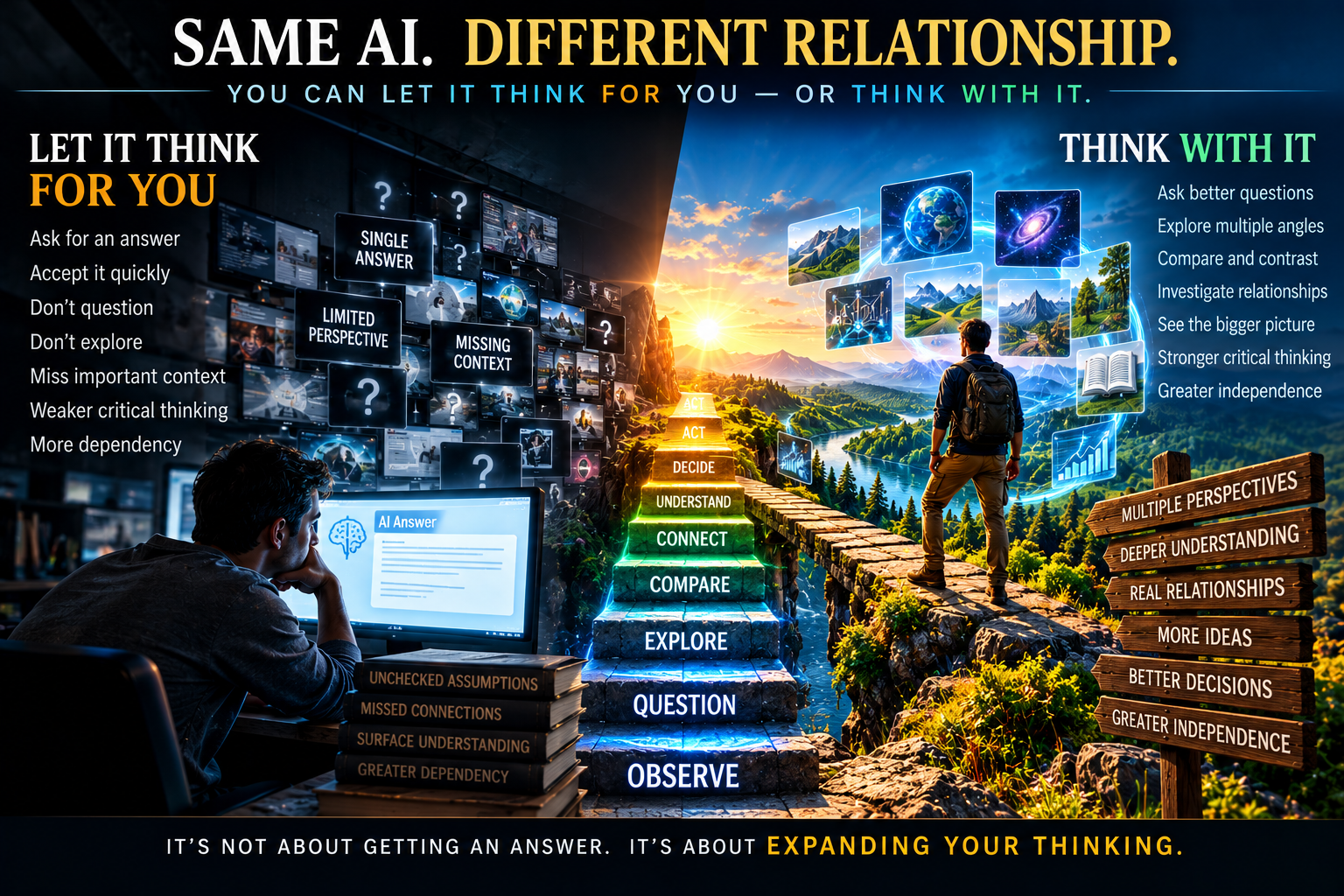
The purpose is not to turn every user into a researcher or make every conversation difficult. It is to preserve the possibility of independent judgment while giving people machinery capable of expanding what they can examine.
APDD intends to test whether that design actually works. Until the evidence supports a stronger conclusion, APDD should not claim that ATLAS improves critical thinking merely because that is what it was designed to do.
What should happen to the intelligence of the person using the tool?
That may be the deeper question.
AI systems will continue to become more capable. They will answer more questions, perform more tasks and reduce more forms of effort. APDD believes capability alone is not the complete measure of an intelligent tool.
The ultimate measure of an intelligent tool shouldn't only be what the tool can do. It should also include what happens to the intelligence of the person using it.
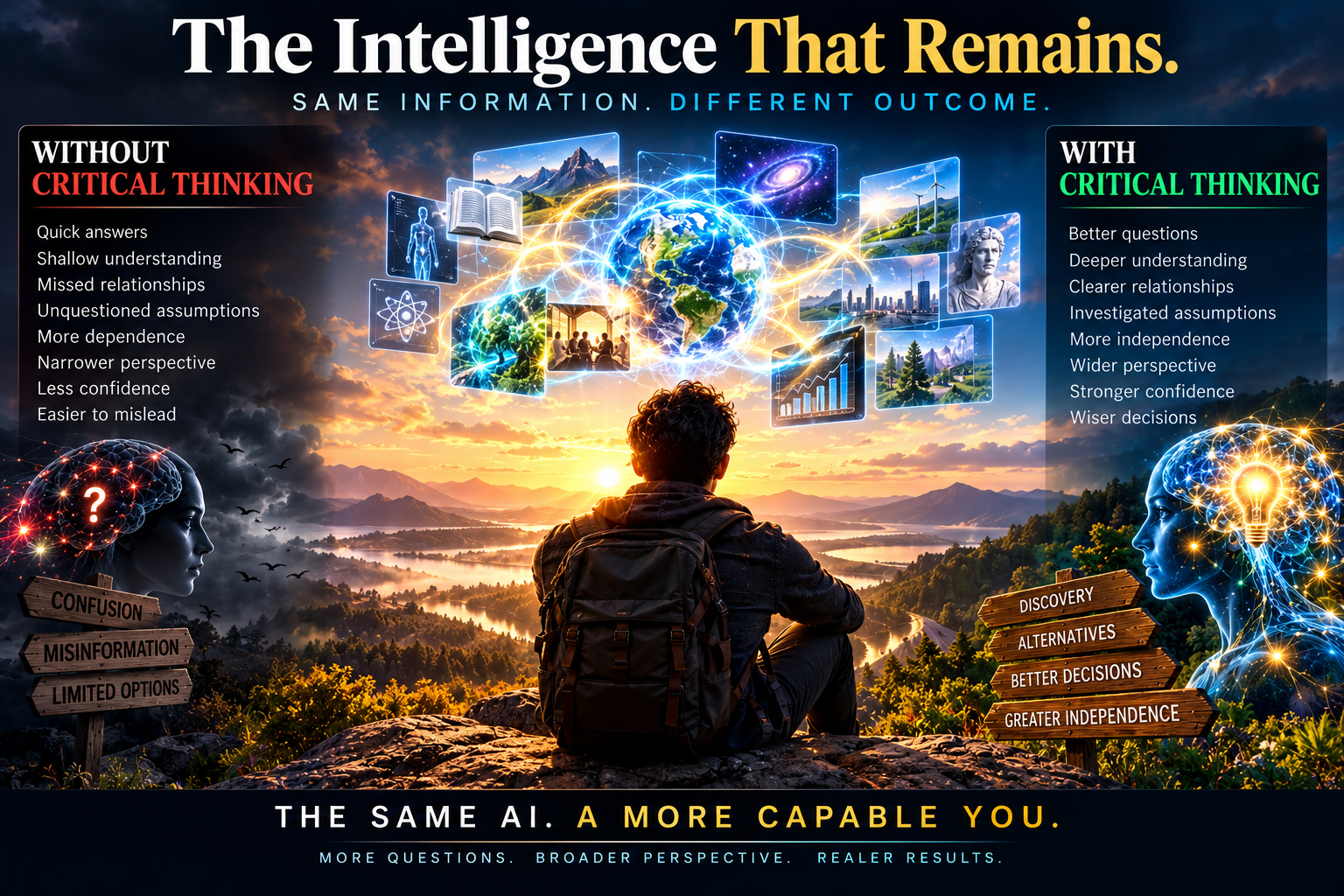
ATLAS is not only being developed to answer questions. It is being developed to help people become better at asking them - to investigate more carefully, recognize uncertainty, discover relationships, challenge assumptions, examine alternatives and learn from what reality teaches next.
Bring ATLAS the question. Then keep examining.
Bring ATLAS the question ->Research informing the question
APDD's public claims should remain proportional to evidence. Relevant research includes the 2025 CHI study "The Impact of Generative AI on Critical Thinking" (Lee et al., Microsoft Research/ACM), Microsoft Research's Tools for Thought work, and the systematic review "Automation bias and verification complexity." These sources motivate testing; they do not establish that ATLAS itself improves critical thinking.
Public production release and scale reliability remain subject to testing. APDD will not represent a pre-release state as finished production.