
THE QUESTION IS YOURS.
What do you want to understand, investigate, research, analyze, examine, question, compare, challenge, verify, explore, or discover?
Start with what matters to you. ATLAS is being developed as APDD's public investigative doorway: a place to bring a question, a claim, a problem, a comparison, an unfamiliar subject, a difficult decision, or something that simply does not make sense yet.
Questions * Problems * Claims * Evidence * Ideas * Decisions * Comparisons * Relationships * Alternatives * Possibilities * Contradictions * Uncertainty * Research * Discovery
DON'T SEE YOUR SUBJECT?
Ask anyway. These examples are starting points, not boundaries. The subject can begin narrowly or broadly. Investigation can then follow the relationships that become visible rather than forcing the question into a predetermined category.
What is ATLAS?
ATLAS is the public investigative research and analysis capability through which people can engage APDD with questions that deserve more than a surface answer. Its purpose is not merely to retrieve information. It is to help examine what the information means, how pieces relate, where evidence agrees or conflicts, which assumptions are shaping a conclusion, and what remains unresolved.
An investigation may begin with a factual question and expand into comparison. It may begin with a claim and move toward source verification. It may begin with a problem and reveal several competing explanations. It may uncover a relationship that was not apparent at the beginning. ATLAS is intended to support that movement without pretending that every inquiry ends in certainty.
Research, analysis and investigation are related but not identical. Research can gather material. Analysis can distinguish and compare it. Investigation can keep asking what follows from it, what contradicts it, what is missing, and what deserves another look. ATLAS brings those activities into one public doorway.
How does ATLAS examine a question?
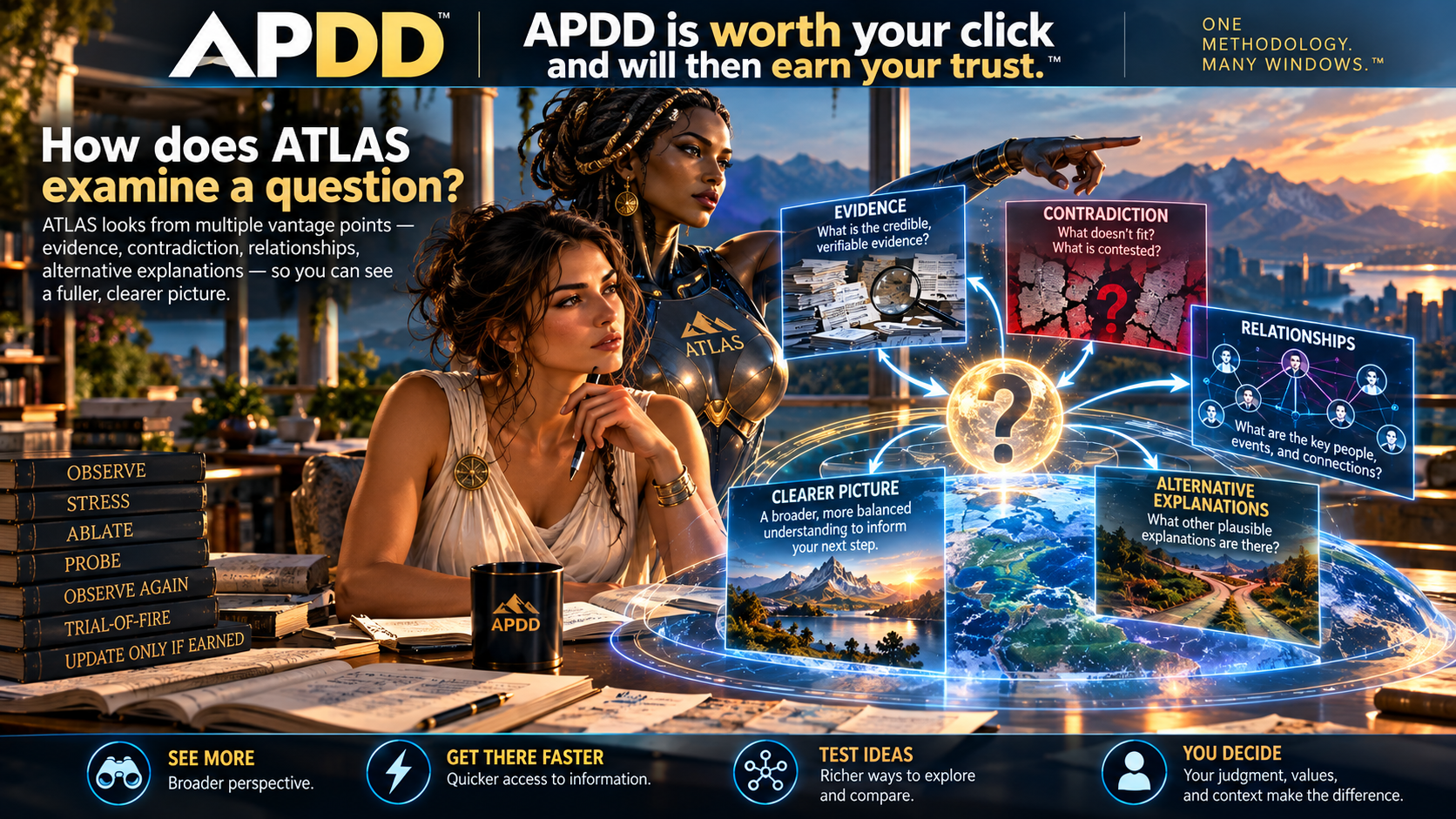
QUESTION IT
Ask what may be missing, uncertain, unsupported, assumed, ambiguous, or dependent on a particular source or definition.
CHALLENGE IT
Push against an explanation. Look for counterevidence, contradictions, alternative causes, competing hypotheses and facts that would change the conclusion.
CHANGE THE VANTAGE POINT
Examine the matter from another position, scale, time frame, comparison, stakeholder, relationship or set of assumptions.
KEEP GOING
Use an answer to generate the next useful question instead of automatically treating the first plausible explanation as the end.
Not every question requires every move. A straightforward request should remain straightforward. But when the matter is uncertain, consequential, disputed or complex, ATLAS can widen the examination rather than compress complexity into false confidence.
Evidence matters. So does uncertainty.

A useful investigative system must distinguish what is known from what is inferred. It should identify the source of a factual claim when verification matters, separate evidence from interpretation, recognize when sources conflict, and say when available information is incomplete. A confident sentence is not a substitute for evidence.
ATLAS should also distinguish disagreement from uncertainty. Two sources can disagree because they use different data, definitions, populations, time periods or assumptions. Sometimes the evidence favors one explanation. Sometimes the evidence is genuinely mixed. Sometimes the information needed to decide is not available. Those are different states and should not be flattened into the same answer.
Verification therefore matters twice: first when examining the material itself, and again when examining the conclusion drawn from it. Research on automation bias has long documented the risk of over-relying on automated decision support, especially when verification is cognitively demanding. That is one reason APDD treats challenge and verification as features rather than inconveniences.
What happens when information conflicts?
Conflict is not automatically a failure. It can be information. A contradiction may reveal that two claims cannot both be true, but it may also reveal different definitions, contexts, measurements or time frames. ATLAS should surface the conflict and investigate its source rather than silently choosing the version that produces the neatest answer.
Where appropriate, the next questions become: What evidence supports each position? Are the sources independent? Are they discussing the same thing? Which evidence is current? What assumptions differ? What would resolve the disagreement? What remains uncertain even after comparison?
No dead-end conclusions.
An unresolved question can still produce a useful result: a clearer map of what is known, what is contested, what is missing, and what evidence would move the investigation forward.
What can ATLAS do for me?
You may use ATLAS to research an unfamiliar subject, investigate a claim, compare alternatives, examine a problem, understand evidence, discover connections, challenge an assumption, test an idea, explore consequences, identify missing information, or develop better questions before making a decision.
The value is not limited to subjects with a single correct answer. Many real questions involve tradeoffs, incomplete evidence, changing information or several reasonable interpretations. In those cases, useful analysis may mean making the relationships visible: what changes if one assumption changes, which consequences belong to which option, where evidence is strong, and where judgment is still required.
ATLAS can also help turn an unclear concern into an investigable question. "Something seems wrong" can become a set of claims to test. "Which is better?" can become a comparison of explicit criteria. "Why did this happen?" can become competing causal explanations. "Can I trust this?" can become an examination of sources, evidence, incentives, corroboration and uncertainty.
Does AI expand your thinking - or outsource it?

APDD believes that question should be investigated, not answered with a slogan. ATLAS is being developed to expose assumptions, alternatives, evidence, uncertainty, contradictions and additional questions - not to ask you to surrender your judgment.
ATLAS isn't only being developed to answer questions. It is being developed to help people become better at asking them.
Sometimes the useful result is an answer. Sometimes it is a better question, an overlooked alternative, a distinction that changes the problem, or recognition that the evidence does not support the confidence of the original claim.
APDD is developing a dedicated Critical Thinking program around this question, including ways to examine whether understanding survives after AI assistance is removed. Self-reported improvement matters, but it is not proof of independent learning. The stronger test is what a person can subsequently recognize, explain, challenge and solve without the machinery doing the work for them.
The question is yours. Your judgment remains yours.
EXPLORE APDD & CRITICAL THINKING ->What do I get?
You get an investigative starting point and, where the subject warrants it, a structured path for continuing the examination. That can include findings, source-supported facts, comparisons, competing explanations, relevant relationships, uncertainties, contradictions, alternatives, assumptions to test, and useful next questions.
You should also get boundaries. If evidence is weak, ATLAS should say so. If a conclusion depends on an assumption, that dependency should be visible. If information is current only to a particular date or applies only to a particular population, that context matters. If the available evidence cannot responsibly answer the question, ATLAS should not manufacture certainty to make the response feel complete.
And you remain free to challenge the result. Ask for the evidence. Ask what could be wrong. Ask for the strongest competing explanation. Change the vantage point. Ask what information would reverse the conclusion. Investigation remains open to correction when reality teaches something different.
You don't have to accept the first answer.
ATLAS is designed to support continued investigation, inquiry, research, analysis, comparison, evidence review and discovery rather than turn an answer into a stopping point.
Bring ATLAS the question.
APDD will show you what it can support, what remains uncertain, and where further examination may be useful.
NEXT: SEE WHAT APDD CAN DO NOW -> REVISIT HOW APDD ASKS TO BE TESTED ->Public production release and scale reliability are still being tested. APDD will not represent a pre-release state as finished production.
APDD - ONE METHODOLOGY. MANY WINDOWS.(TM)