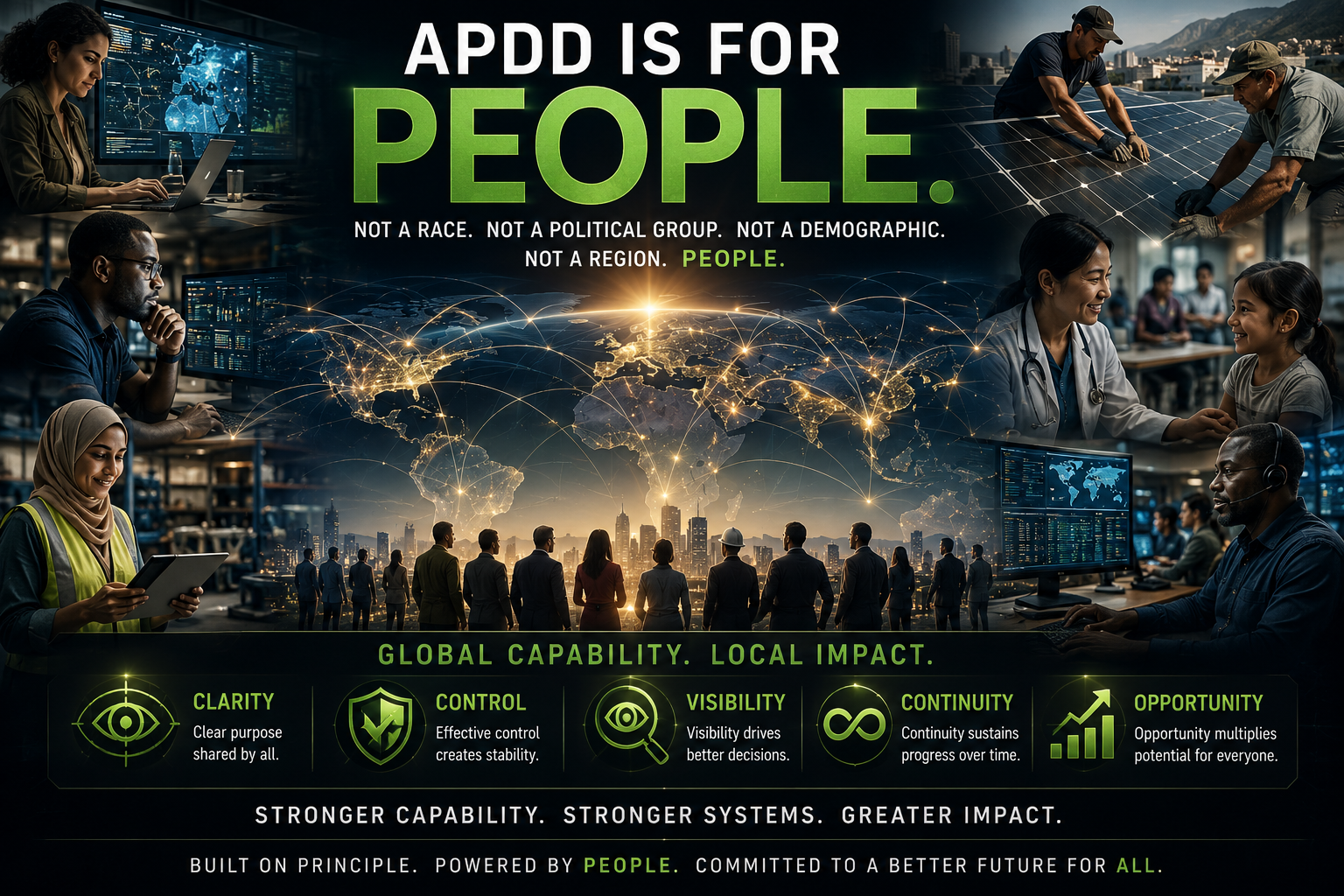
Built in Denver. Designed for broader reach. APDD develops a disciplined, repeatable way to investigate difficult problems, challenge assumptions, evaluate alternatives, make evidence-based decisions, build practical capability, and correct what does not survive reality.
THE APDD COMMITMENT
The care is not separate from the product. The care is part of the product.
We design, test, explain, and correct with the people who use APDD in mind. That commitment must be demonstrated through results.
WHAT IS METHODOLOGY?
One disciplined way of thinking can support many different kinds of work.
Methodology is the overarching system of principles, reasoning, procedures, tests, and rules used to investigate questions, solve problems, make decisions, execute tasks, and evaluate whether the chosen approach actually works.
Overarching System - See the Whole
A methodology is larger than any single method or tool. It asks how the parts relate, which conditions matter, what evidence is available, what is missing, and how a result should return to the system for further examination. APDD begins by asking what whole we are dealing with, what part of that whole is presently visible, and what may be hidden by position, habit, missing information, or unnecessary boundaries.
Principles - Govern the Work
Principles establish what should remain true even when the subject changes. APDD separates evidence from assumption, examines relationships, exposes uncertainty, preserves what passes, corrects what fails, and refuses to upgrade a claim simply because the preferred answer would be convenient. The application may change. The discipline does not.
Procedure - Make Thinking Repeatable
A methodology needs more than improvisation. APDD uses a repeatable operating path: OBSERVE → UNDERSTAND → ORGANIZE → DECIDE → ACT WHERE APPROPRIATE → VERIFY → CORRECT → OBSERVE AGAIN. Different problems may require different methods, but they do not excuse undisciplined thinking.
Strategy - Choose the Approach
Strategy asks more than "What do we do next?" It asks which approach gives us the best opportunity to understand the actual condition before acting on it. APDD may change vantage point, compare alternatives, examine relationships, work backward from an outcome, work forward from available capabilities, test competing explanations, or combine approaches when the evidence warrants it.
05:00
Untimed by default. Take the time you need. Click a starting point, then four more points to draw four connected straight lines. You may draw beyond the dots.
THE NINE-DOT QUESTION
What if the boundary is not really there?
The classic nine-dot puzzle asks you to connect all nine dots with four straight, connected lines without lifting your drawing instrument. Many people unconsciously treat the three-by-three arrangement as though a box surrounds it. But no box was drawn. The boundary can exist entirely in the solver's interpretation of the problem.
Where did the boundary come from? Not from the dots. It came from an assumption about the dots.
Assumptions - Useful Until They Become Invisible
Experience, convention, habit, inherited knowledge, and previously successful methods help people function efficiently. They become limiting when an assumption is mistaken for an unchangeable fact. "That's just the way it is" may describe reality - or it may describe a belief that has not been re-examined for years. APDD does not assume the boundary is false. APDD investigates whether the boundary is real. One practical purpose is to identify hidden assumptions before they are mistaken for fixed limits.
Fear, uncertainty, social expectations, long-held beliefs, limited information, prior failure, and familiar routines can all influence what a person or organization considers possible. They are not automatically wrong, and they are not the only forces that shape outcomes. The disciplined question is: What have we accepted as a limitation, and which of those limitations actually survive investigation?
DON'T BREAK THE RULES. FIRST FIND OUT WHICH RULES ACTUALLY EXIST.
Some boundaries are real. Some are assumed. Methodology helps us investigate the difference.
Justification - Explain Why
A useful methodology should expose the reasoning behind important choices. Why was this evidence accepted? Why was that procedure selected? Why was one alternative rejected? Why does a relationship matter? APDD does not want "because the system said so" to become a substitute for understanding. A conclusion becomes more useful when the path that produced it can itself be examined.
Investigation - Find Out Before Claiming
Research and investigation are more than gathering information. APDD looks for relationships, contradictions, missing context, alternative explanations, consequential differences, limits of vantage point, and evidence capable of changing the present interpretation. We remain broad in discovery and strict in what we claim.
Problem Solving - Change What Matters
A systematic way to solve difficult problems does not begin by assuming that more activity is the answer. A problem solving framework for complex problems should make the condition, alternatives, evidence, and consequences easier to examine rather than merely adding activity. Once a consequential condition becomes visible, APDD asks what responsible intervention - if any - is justified. Improvement may mean adding, removing, reducing, increasing, simplifying, combining, separating, reconnecting, resequencing, replacing, delaying, accelerating, or doing nothing at all.
Decision Making - Evaluate Alternatives
Evidence-based decision making requires more than collecting facts. APDD organizes evidence so alternatives, tradeoffs, relationships, uncertainty, and consequences can be compared. A framework for evaluating different solutions should make it easier to understand not merely which options differ, but which differences are consequential enough to matter.
Advanced Computing - New Instruments, Not Automatic Truth
Advanced computers, artificial intelligence, local computing, simulation, information retrieval, automated comparison, and visualization can dramatically expand what people are able to examine. Questions that were once too expensive, too slow, or too complex to investigate may become practical. That changes the degree of what can be explored, but it does not eliminate the need for judgment, evidence, context, verification, or correction.
The computer is not the Methodology. AI is not the Methodology. An APDD application is not the Methodology. Where practical, APDD favors a local-first approach so useful capability can remain closer to the person and the computer performing the work. They are capabilities the Methodology can employ. Yesterday's "we cannot reasonably investigate that" may become today's "why have we not investigated that?"
Execution - Turn Understanding Into Capability
Methodology eventually has to survive contact with reality. APDD applications can investigate, organize, compare, build, measure, visualize, communicate, automate, test, or perform another specialized task. The Methodology guides how the work is approached; the application performs the particular job.
Reliability - Make Capability Dependable
A capability that works once has demonstrated possibility. A capability that continues to perform under repeated use, changing conditions, different inputs, and realistic demands begins to demonstrate reliability.
APDD does not treat a successful demonstration as the end of evaluation. We repeat. We vary conditions. We examine failures. We correct weaknesses. We test again. Where appropriate, a discovered failure becomes part of future testing so that a corrected problem does not quietly return.
Capability asks whether something can work. Reliability asks whether we can reasonably depend on it to keep working.
CAPABILITY MATTERS. RELIABILITY MAKES CAPABILITY USEFUL.(TM)
Reproducibility - Let Others Examine It
If a process cannot be followed, challenged, repeated, or evaluated, confidence should remain limited. APDD aims to expose enough of the path from observation to result that another person can ask what happened, why it happened, what evidence supported it, and what would change the conclusion.
Verification - Make the Result Answer Back
Claims invite questions. Results create evidence. APDD checks whether an intended improvement actually occurred, where performance weakened, what survived, what failed, and whether a correction produced a measurable difference. A technically completed file, feature, or application is not automatically a successful result.
Correction - Let Reality Teach Us
Correction is not embarrassment; it is part of the operating discipline. When stronger evidence, a failed test, an unexpected consequence, or a changed condition reveals a better understanding, APDD updates only what the evidence earns. The correction itself remains open to examination.
Methodology Is Not One Method.
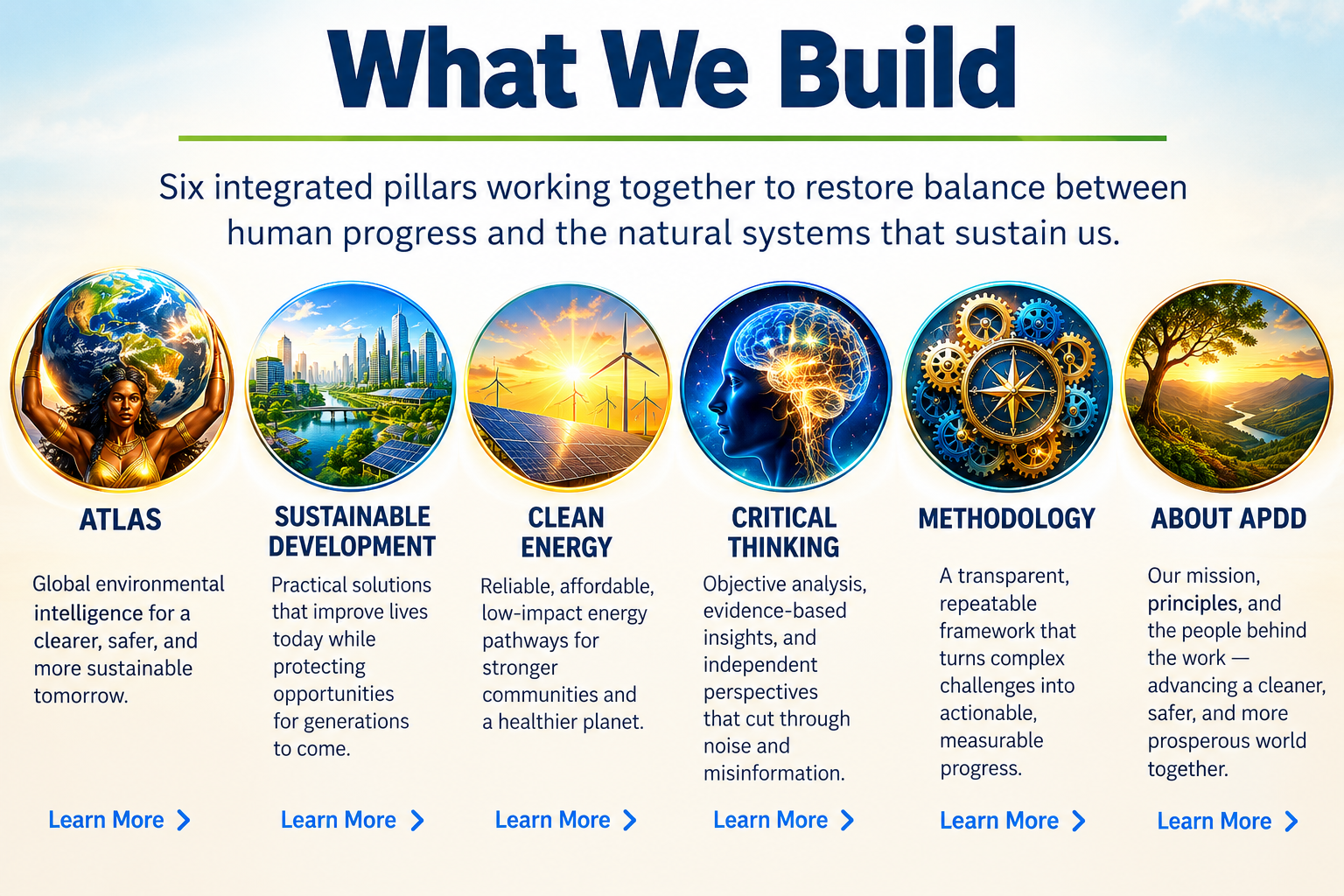
A method is a particular way of doing something. A methodology determines how methods are selected, combined, justified, evaluated, challenged, corrected, and improved. That is why APDD can build very different applications without becoming a collection of unrelated software.
Each application has its own purpose. Each purpose may require different methods. The Methodology determines how those methods are used responsibly.
ONE METHODOLOGY. MANY APPLICATIONS.
Different jobs do not require disconnected thinking.
APDD applications do not all have to be connected or operating at the same time. One application may perform its job entirely by itself. Another problem may benefit from several applications working together. A useful discovery made in one application may eventually become relevant to another.
But nothing automatically spreads merely because APDD discovered it somewhere else. The Methodology asks: Does it apply here? What evidence supports the connection? Would it improve the receiving application? What could it damage? Can we test the transfer? Did the improvement actually occur?
Everything can contribute. Nothing automatically transfers. The Methodology determines what deserves to travel.
APDD Is a Methodology Company.
We investigate before we assume. We seek relationships before isolated answers. We distinguish what merely differs from what actually matters. We challenge assumptions without assuming they are false. We evaluate alternatives. We test before we trust. We act where action is warranted. We measure what happens. We correct when reality teaches something different. And we carry legitimate learning forward only when the evidence earns the transfer.
ONE METHODOLOGY. MANY WINDOWS. MANY CAPABILITIES. ONE DISCIPLINE OF LEARNING FROM REALITY.
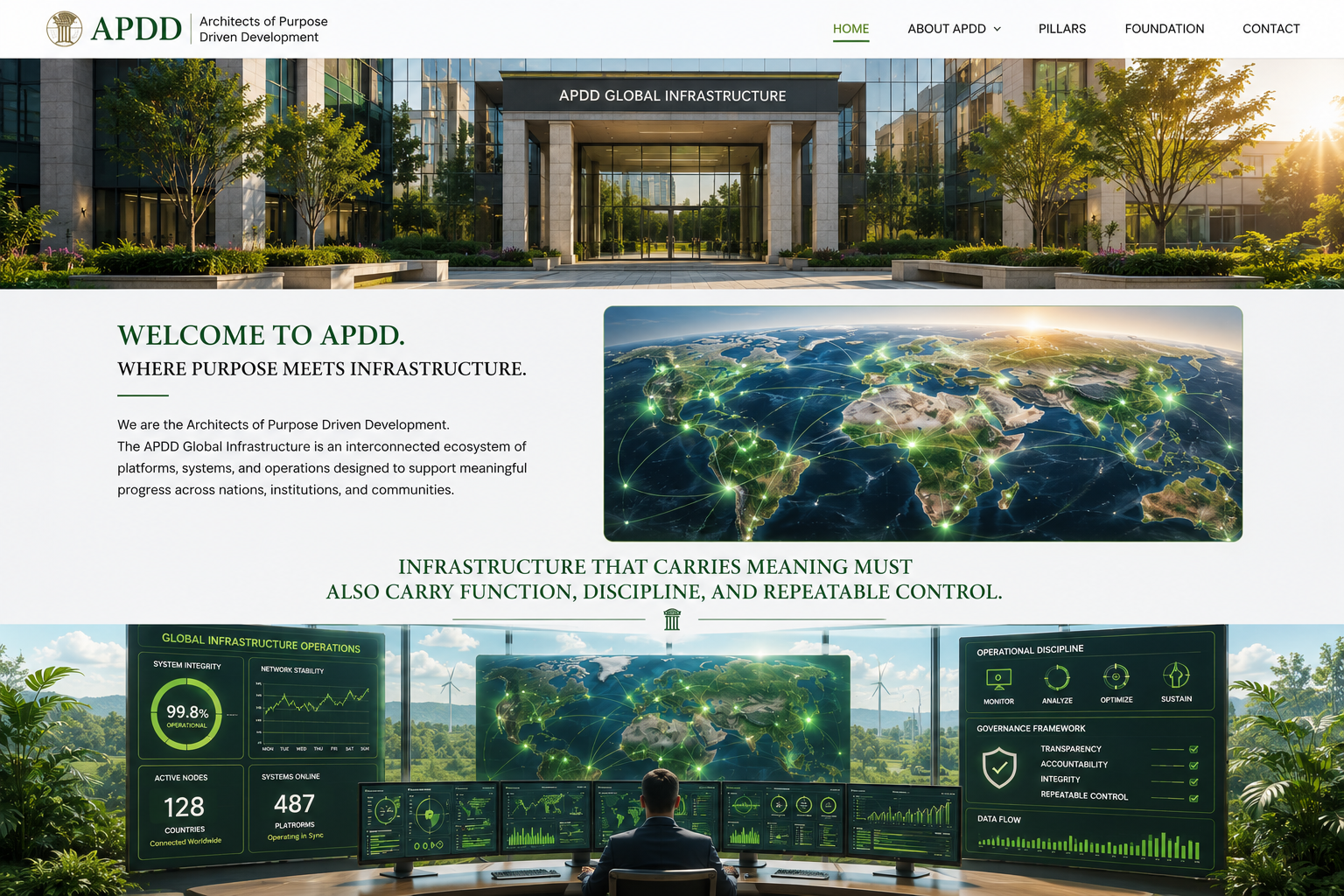
APDD VISION — A conceptual visualization of the infrastructure and connected environment APDD is working toward.
An Invitation to Examine
Before We Continue...
You are about to explore ideas, applications, operational frameworks, and methods of improvement that may differ from approaches you have encountered before.
We are not asking you to endorse APDD.
We are inviting you to challenge it.
Question Our Ideas
Strong ideas should remain open to thoughtful, disciplined examination.
Examine the Evidence
Confidence should grow from what can be observed, evaluated, and understood.
Test the Applications
Practical value should be demonstrated through responsible use under realistic conditions.
Nearly every organization wants better outcomes. APDD begins one step earlier: what conditions are producing the outcomes we see?
Better Outcomes Begin With Better Conditions
Outcomes do not appear by themselves. Conditions influence patterns. Patterns influence decisions. Decisions influence actions. Actions produce results. APDD investigates that chain so improvement can begin where it can actually matter.
Changing a condition does not guarantee a preferred result. It creates a new condition to observe, test, and learn from.
Technology Is a Tool
Technology is not the objective. It earns its place when it improves understanding, organization, communication, capability, or execution.
Features Must Earn Their Place
APDD does not measure success by counting features. We ask whether a capability reduces friction, strengthens usefulness, or helps people understand and act more effectively.
Relationships Matter
Facts become more useful when their relationships are visible. APDD looks for the connections, dependencies, distinctions, and consequences that isolated information can hide.
Our Design Doctrine
Images inspire. HTML explains. Applications demonstrate.
Each part has a job. Each part must help the next part become more useful.
The APDD Way(TM)
The APDD Way(TM) is a disciplined framework for examining conditions, developing understanding, organizing what is learned, applying practical responses, verifying results, and continually improving what we build.
The Operational Cycle
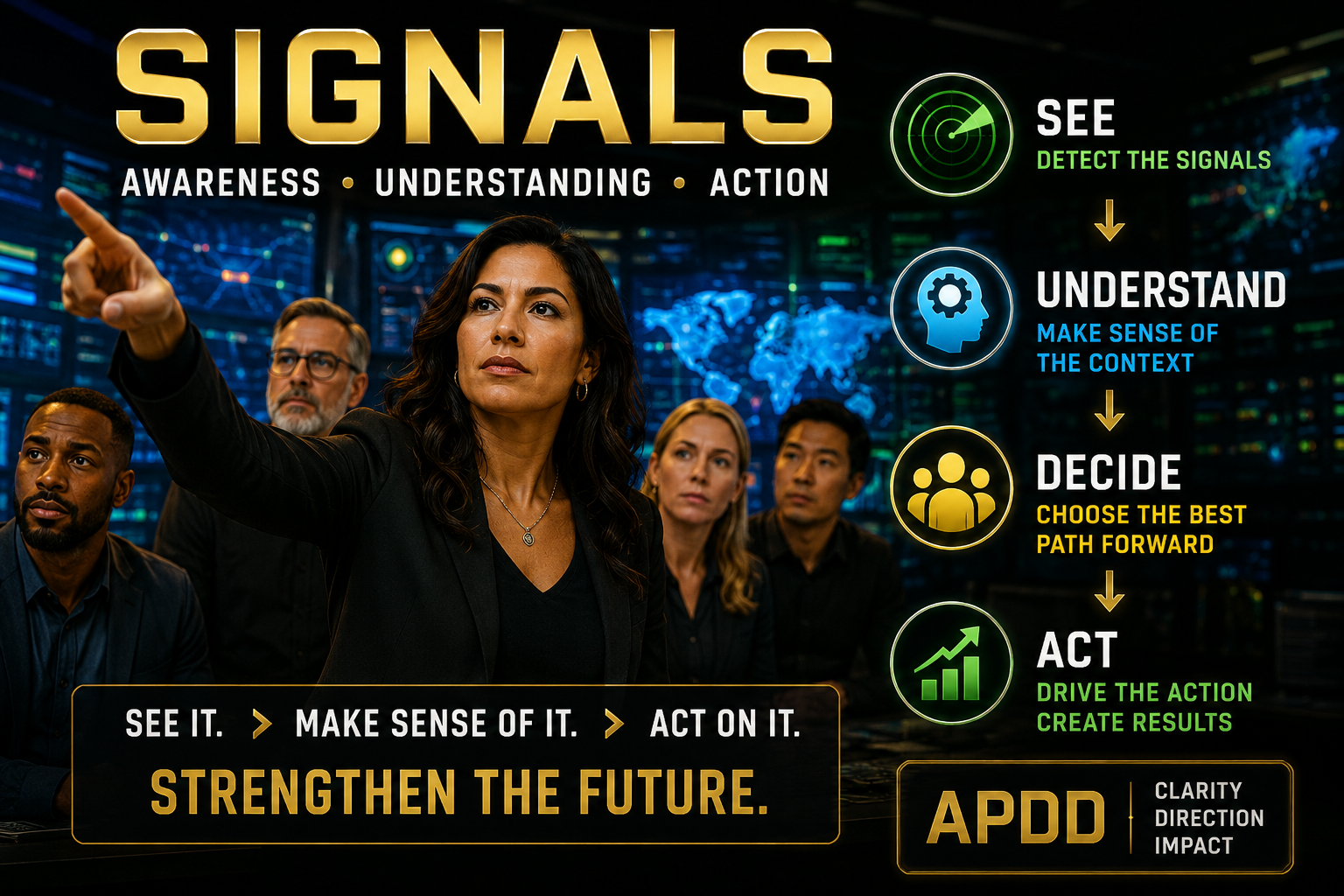
OBSERVE -> UNDERSTAND -> ORGANIZE -> DECIDE -> ACT WHERE APPROPRIATE -> VERIFY -> CORRECT -> OBSERVE AGAIN
The objective is not activity for its own sake. The objective is useful understanding and responsible action that can survive contact with reality.
Observe and Understand
Examine the conditions. Separate evidence from assumption. Identify relationships, uncertainty, friction, and what is not yet known.
Organize and Decide
Turn scattered information into a structure that makes distinctions, alternatives, and consequences easier to see.
Verify and Correct
Observe what actually happens. Preserve what earns confidence, correct what fails, and update the next decision with what reality teaches.
Trial-of-Fire(TM)
If an APDD application fails under realistic examination, it is examined - not defended. We locate the problem, evaluate alternatives, reorganize where necessary, test again, and update only when the evidence earns the change.
The APDD Way(TM) Is a Discipline.
Question thoughtfully. Examine carefully. Organize clearly. Decide deliberately. Act responsibly. Verify honestly. Correct when reality teaches something different.
DON'T BELIEVE APDD? GOOD.
TEST US - TEST US - TEST US.
APDD does not ask for belief in advance. Bring something real, question the reasoning, challenge the evidence, push the conclusion, and see what survives examination.
Make Us Explain It
Ask what APDD knows, what it does not know, what evidence supports the present conclusion, and what would change it.
Try to Break the Reasoning
Challenge assumptions, test contradictions, introduce competing explanations, and make the system account for uncertainty instead of hiding it.
You Decide
APDD can investigate, organize, compare, explain, and test. The final judgment remains yours. Confidence should be earned by what survives examination.
TEST THE DAMN THING.
If our claims cannot survive your examination, they have not earned your belief.
APDD is a methodology company first. The Methodology governs how APDD investigates, understands, tests, verifies, learns, corrects, and determines what deserves action.
Capabilities come second: applications, investigative experiences, infrastructure websites, regular websites, and other practical systems are expressions of that Methodology - not the definition of APDD itself.
Access Before Unnecessary Construction
Methodology first. Capabilities second. Access and leasing wherever appropriate. Custom building when the need earns it.
When an existing APDD capability can address the need through access, leasing, or another appropriate arrangement, a new custom build may not be necessary. When the need genuinely requires something new, APDD can build at a high level of expertise - including purpose-built applications, infrastructure websites, and focused professional websites.
The website is not the whole capability. It is a window into it.
1. Methodology
The disciplined investigative and development system that governs how APDD observes, questions, builds, tests, verifies, learns, and corrects.
2. Application Development
Purpose-built applications that turn a defined need into usable capability, with the Methodology governing how the application is investigated, built, tested, and improved.
3. Infrastructure Websites
Higher-scope web systems in which the website is part of a broader operational infrastructure: applications, workflows, information, controls, integrations, or other functional systems may work together behind the public surface.
4. Regular Websites
Focused websites for organizations, services, information, presentation, communication, and ordinary web needs without requiring the larger infrastructure architecture of an infrastructure website.
One Methodology. Many Expressions.
Every APDD application is unique in what it does. Every APDD application is unified in how it thinks.
The product is not more technology. The product is greater useful capability.
THE WORLD TALKS. APDD LISTENS.
APDD learns from the questions people are already asking.
APDD does not assume that what people need today is necessarily what they will need tomorrow. We observe how people describe problems, where explanations remain unclear, what relationships may have been overlooked, what capabilities may be missing, and where no change is justified at all.
Language
Sometimes APDD can already help, but describes the capability differently from the people looking for it.
Explanation
Sometimes an idea is present but not yet clear enough to be useful.
Relationship
Sometimes the pieces already exist but the connection between them has not been made visible.
Demonstration
Sometimes a claim needs a better test, example, or visible proof.
Capability
Sometimes the outside world exposes a legitimate need that APDD does not yet completely address.
No Action
Sometimes an interesting opportunity does not deserve pursuit. Discovery alone does not earn action.
Traffic Does Not Get a Vote Over Truth.
A popular idea is not automatically a useful idea. Search demand does not make something true. APDD investigates first, builds or improves only when the relationship is legitimate, and remains willing to say no when the evidence does not earn the change.
WORLD → APDD → INVESTIGATE → BUILD/IMPROVE WHEN EARNED → WORLD → OBSERVE THE RESULT → LEARN → CORRECT ↻
Built in Denver. Designed for Broader Reach.
From Methodology to Demonstration
APDD is developed in Denver, Colorado, with a broader purpose: create practical systems that people can examine, use, challenge, and improve.
Bring something you genuinely care about.
Let APDD investigate it. Challenge the reasoning. Try to break it. See what survives.
The sections that follow - and the applications themselves - must earn credibility the same way: through performance, evidence, correction, and demonstrated usefulness.
CAPABILITY WITH DISCIPLINE
The Application Is Not the Methodology.
You may use one APDD application and never see another. You may use several that work together. Behind each is the same disciplined approach to observing, understanding, testing, verifying, and correcting.
The applications are different expressions of capability. The Methodology is what keeps those capabilities from becoming disconnected tools.
One application may discover something useful. Another may help examine it. Another may turn it into something practical. Another may test whether it actually worked.
They do not all have to work together. They have the ability to work together when the problem earns the relationship.
ONE METHODOLOGY. MANY CAPABILITIES. CONNECTED WHEN USEFUL. INDEPENDENT WHEN APPROPRIATE.
APDD VIDEO
Opening Video Coming Soon
APDD's opening video is in final production. The complete website is available now; the video will be added after it completes the same review and verification standards used throughout APDD.